
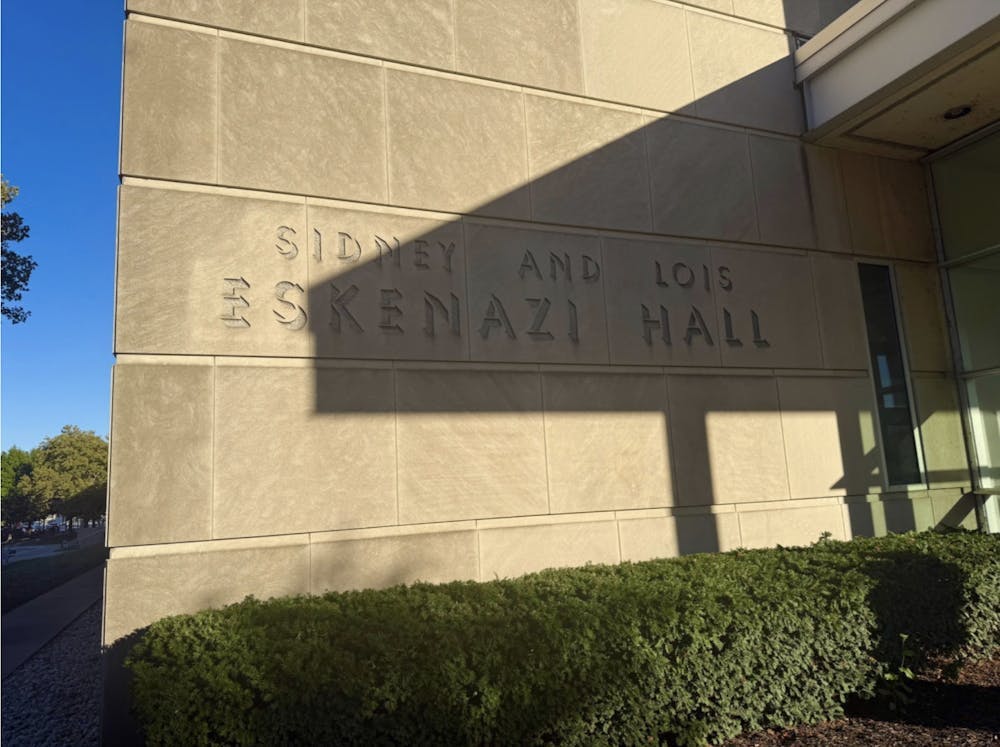
On Oct. 6, IU Indianapolis’ Parking and Transportation Services announced that lots 402 and 403, located near the Eskenazi Fine Arts Center (EFAC), will be closed until 2027 to make way for the new IU LAB building, according to an IU Indianapolis Today newsletter.
All vehicle owners were asked to vacate the lots by 6 p.m. on Oct. 10, or relocate to another lot. Holders of NCS parking permits were directed to nearby available options like lots 401 and 408 that come with the parking permit. Lot 401 is located across the street of EFAC, while Lot 408 is about a 15 minute walk.
The Herron School of Art and Design operates between two buildings located 32 minutes away apart by walking, both primarily used by Herron students.
The closure has frustrated students who primarily use the north side of campus for their classes in EFAC—many of these Herron students—who had purchased parking permits expecting to be able to use Lots 402 and 403 for the remainder of the semester.
According to permit rates and sales data provided by IU Indianapolis, NCS parking passes cost $155.30 per academic year, making them the most affordable option. The next available permits, which give access to other campus lots, cost $313.60 or $485.90 per academic year.
The $319.60 options are for commuter and disabled students, and the $485.90 options are for students living on-campus housing for parking spaces near resident halls.
In a PDF sent out to students, the school listed other parking options and their monthly rates. This includes the AMP Parking at the 16 TECH HQP Lot, and the 16 Tech Garage.
Emily Loper, a drawing and illustration major, said the option seemed unreasonable given the prices. A student who parks for two to four hours a day at $5 per visit would pay about $25 a five-day week, or $800 over a 32-week school year, not including breaks. $800 is about double the amount for the other parking pass options available to purchase. For someone who spends more than six hours on campus daily, the cost could rise to about $3,200 for the year.
Students, like Loper, at Herron were blindsided by the short notice. Oct. 6 was when the post on the IU website was uploaded, and the newsletter was distributed to student email accounts on Oct. 7, but the closure notice was found at the bottom of the list.
Loper said that she first received a direct notice about the closures through the Herron advising Canvas page on Oct. 10–the same day students were expected to move their vehicles from the lots. She said many other students also first learned about the closure through the same source.
Graduate students did not receive an email directly from the school about the changes, but instead from the head of Herron’s graduate program.
In a previously posted article “LETTER: Lot 403 Closure Impacting Herron Students,” Claire Edwards, a ceramic and sculpture major, expressed a similar sentiment among Herron students regarding the NCS parking permits.
“Information regarding the lot closure was knowingly withheld from students purchasing NC Lot passes,” Edwards wrote. “Many of us coordinated our school and work schedules relying on direct transportation to the Eskenazi Fine Arts Center. Out of money and blindsided, the only advice we were offered was to park in the lot across the street, which can clearly not accommodate us all.”
Even before construction, students had limited spaces and had to park alongside the street to remain close to EFAC. Lot 401, recommended to students, is the smallest parking lot for NCS holders near EFAC, while Lots 403 and 408 are the largest. By closing Lot 403, parking spaces for students have decreased significantly.
“When I was a freshman, I had an [NC] permit,” said Loper. “I would park in the gravel area sometimes, and then one time on my way home, I found out that I had a nail in my tire. That’s not good.”
In an email sent to Andrew McGee, the associate director of Parking and Transportation Services, Kate Luce, a Master of Fine Arts Candidate at Herron and Graduate and Professional Student Government representative, raised concerns about the safety of students in lots 401 and 408.
According to the IUPD Daily Crime logs, multiple incidents have occurred recently in both lots. On Sept. 8, a report of aggravated assault took place in lot 401, while two reports of intimidation and unlawful entry of a motor vehicle were filed in lot 408 the same day.
“These types of reports do not make any of our students or faculty safe if they have to walk back to their vehicles at night,” Luce wrote in the email. “We expect a safe environment for learning and creating, and with these reports, it does not seem this closure is conducive to the University’s goals.”
McGee later forwarded Luce’s message to the director of Parking and Transportation Services, who has not responded to her.
Luce voiced her worries about students who are new to Indianapolis and may not be familiar with the area.
“We live in Indy—some of us aren’t from here—so a lot of us don’t know the area super well,” Luce said. “We moved to a bigger city than we’re used to, so safety is a major concern. Especially if you have to walk really far late at night to get to your car in areas that might not be the safest. It just makes me worried for them as well.”
While lot 401 may seem like a convenient alternative from an administrative standpoint, students have expressed concern about crossing Indiana Avenue, where cars frequently speed past at night, when many students leave the studio.
“There have been some safety concerns, not only because of the assaults and those other things that happened,” Luce said. “With the parking lot, we have to cross Indiana Avenue, and there are cars that go by super fast. That’s also an issue we need to address because if we’re essentially jaywalking across the street with heavy equipment, that’s concerning.”
Herron students frequently transport their artwork between Eskenazi Hall and EFAC, which can be challenging for those working with large or heavy materials.
“In November, I have to carry four big 30-by-40 paintings and they barely fit in my car,” Luce said. “They’re like 10 pounds each, so I have to carry about 40 pounds. Some people work a lot bigger than I do, and some use metal and other heavy sculptural elements that weigh more than canvas does. It’s still—how are we going to carry everything over there?”
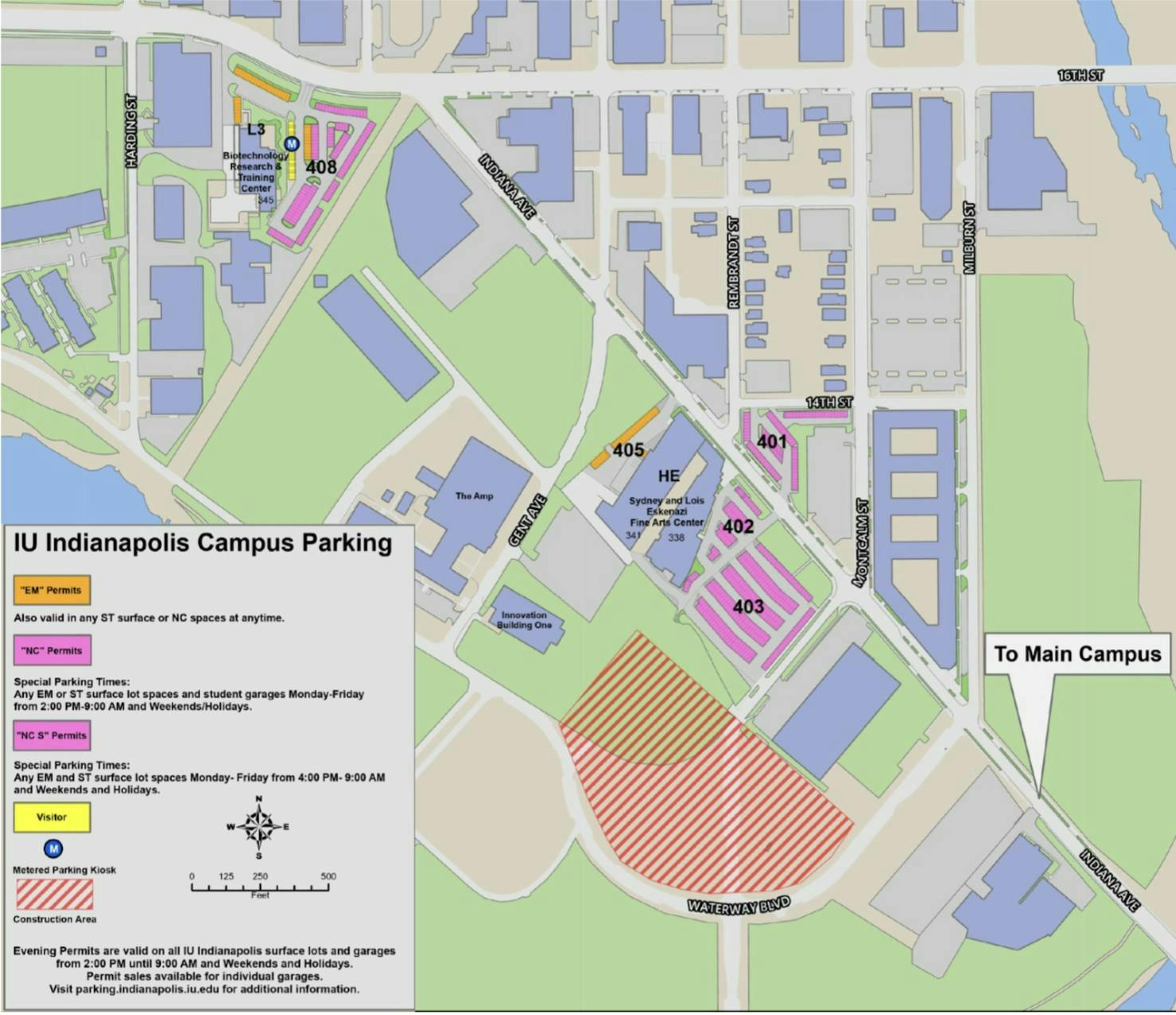
A map of IU Indianapolis campus parking in the northside of campus. (Photo Courtesy of IU Indianapolis)
Parking and Transportation Services also suggested the JAGLINE’s, IU Indianapolis’ student shuttle bus, blue route as an alternative. The route operates between north campus and the west side of main campus Monday through Friday from 5:30 a.m. to 12:15 a.m..
The JAGLINE has also been labeled as unreliable by students on campus who complain about constant delay and waittime.
“Not only is it unsafe, but it is inconsistent and unpredictable,” Edwards writes. “Its use will lead to students waiting at inadequate bus stops for extended periods of time. Not to mention, it does not run on the weekend and undermines Herron’s main selling point: its 24/7 studio access. Inadequate parking and no operating shuttles will limit student’s quality of education.”
Herron students often take advantage of the school’s 24-hour studio access, working between 12:15 a.m. and 5:30 a.m. or on weekends – times when the blue route does not operate, leading to frustration with the administration providing the jagline as a reasonable accommodation.
“We have access to these studios 24/7, so a lot of us do try to take advantage of it,” said Luce. “It’s hard to make art, especially big work, at home when there’s not a whole lot of room or dedicated space. So we try to take advantage of it as much as possible.”
Herron hosts major events at EFAC, including the annual Wearable Fashion Show, senior thesis shows and graduate exhibitions, which serve as networking opportunities for students and members of the Indianapolis art community. With limited parking, students fear attendance and participation could decline, potentially affecting their future career opportunities.
The IU LAB building is a 150,000-square-foot addition to campus, expected to provide more support for students in STEM fields. It received a grant of $138 million from the Lilly Endowment.
Students who reached out to Parking and Transportation Services said they were either directed to refund forms or told their concerns have been heard – without any follow-up action.
“We wish there was better communication with the school,” Luce said. “We’re graduate students. We came here because we love the facilities and the faculty. Having 24/7 studio access is a great benefit, and I just worry that this might dissuade not only future grad students but undergrad students as well from attending, especially since this is lasting so long. This is a long project. I just wish they communicated better. I think that’s the whole point.”
Melanie Contreras is a sophomore majoring in journalism with a minor in video production and a paralegal studies certificate in progress. She is the culture and politics editor for The Campus Citizen. She enjoys drinking coffee and being a social advocate for the community.

Making space to create: Why Herron’s National Portfolio Day belongs to the whole campus
By Sarah Pinckard | Sept. 10Herron School of Art and Design will host National Portfolio Day on Saturday, giving prospective students a chance to present their work to art and design schools from across the country accredited by the National Association of Schools of Art and Design. The event runs like a college fair, with students meeting representatives from the schools they choose and looking for the place they fit as an emerging artist.
The study abroad fair: opportunity beyond U.S. borders
By Devin Bates | Sept. 7The Division of Student Affairs is holding a series of welcome and opportunity events for students as part of Weeks of Welcome, a two-week run of expos and programs at the start of the semester aimed at getting students involved on campus and abroad.

Troi Wharton had to learn how to walk again. Ten years later, she walked the Kelley graduation stage.
By Salsabil F. Qaddoura | May 31Troi Wharton remembers the first time people noticed she could not walk straight. It was 2016, and Pokémon Go had taken over the summer. Wharton, then 20, was playing the game around Indianapolis with friends and family. At the canal. At the zoo. Anywhere her phone told her another Pokémon might appear. The game required players to physically move through the real world. For Wharton, that meant walking more than usual. For the people around her, it meant seeing what she had not yet accepted.
