
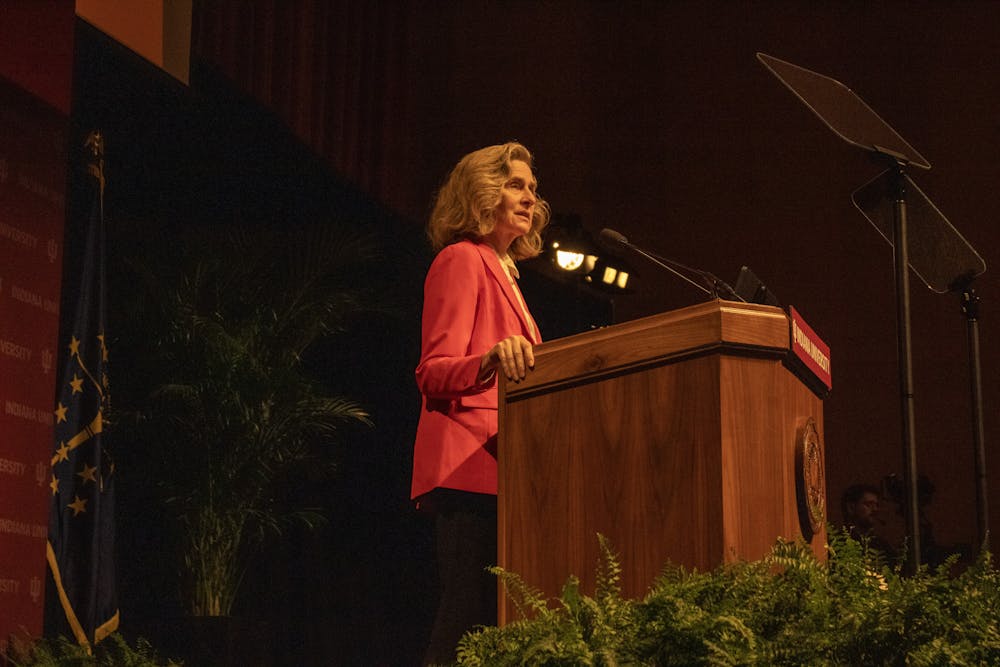
On Dec. 9, Indiana University President Pamela Whitten delivered her 2025 State of the University address at IU Indianapolis with an emphasis on the IU 2030 strategic plan, a plan set forth that aims to reaffirm the university's place in public education.
The three foundational pillars discussed from the IU 2030 strategic plan are enhancing students' success and opportunity, research and deepening connections across the state.
First pillar: Student success and opportunity
Enhancements to students’ success and opportunity at IU include holding in-state tuition flat, improving university systems statewide, introducing new advising software, adding to the curriculum and encouraging students to use artificial intelligence (AI) properly.
“For our students, being too good not to become even better means pressing further to drive affordability,” said Whitten when introducing the first pillar. “ It means simplifying and streamlining the systems that serve and support students, from advising to general education requirements. And it means relentlessly creating, expanding and evolving academic programs and experiential opportunities that meet the needs of today's students, while also preparing them to think critically to solve complex problems and engage as active citizens in their communities.”
Affordability efforts include keeping in-state tuition flat, cutting mandatory fees, increasing graduate stipends and raising $109 million in philanthropic support for student financial aid. Whitten said 55% of IU undergraduates now graduate with zero student loan debt.
“Our efforts to preserve and enhance affordability are central to our public mission,” said Whitten. “Talent is everywhere in Indiana. Opportunity must be too. At IU we pair affordability with opportunity, because the true measure of value is whether a degree changes lives.”
Whitten also highlighted IU’s strength in study abroad, noting in her speech that the university ranks fourth in the nation and first in the state. She also mentioned a partnership between the Kelly School of Business at IU Indianapolis and Eli Lilly.
To further expand the success of the program, IU will be opening a Capital campus in Washington, D.C. in summer 2026.
“ This presence will give our students unparalleled opportunities to develop as civic leaders,” said Whitten. “And to engage with leading professionals in technology, business, media, law, the arts and many other fields.”
IU’s new advising system, Stellic, was also featured in the address. Stellic is a new platform for registration, degree tracking and advising that utilizes AI to identify at-risk students, allowing advisors to intervene earlier in order to encourage students to stay on track for graduation.
The system has been rolling out since spring 2025, with IU Indianapolis students gaining access this semester.
“ The impact is immediate,” Whitten said about the success of the new system. “This fall, early advising participation rose by [13%] overall, and 62% of these at-risk students successfully met with an advisor, effectively closing critical engagement gaps.”
Whitten also announced several new degrees during the address. IU Indianapolis introduced new programs in biomedical sciences, the business of biotechnology, biomedical engineering and biochemistry.
The Luddy School of Informatics, Computing and Engineering at IU Bloomington will also be introducing new degree programs in computer engineering, robotics, bio engineering, nanoengineering, bioelectronics and electrical engineering.
“Now, if our Big Ten football program has taught us anything,” said Whitten. “It's that we can excel at building new strengths. Indiana University is now home to emerging football and engineering powerhouses.”
Whitten also addresses the introduction of the new Gen AI 101 course which introduces AI tools to students and faculty as AI becomes more prominent worldwide.
Second pillar: Commitment to research
Whitten discussed major expansions in research funding. She said that IU has reached $1 billion in annual research expenditures, which is a 34% increase compared to 2021.
“To sustain this, we are investing over $250 million to solidify Indiana as a global leader in life sciences,” said Whitten. "The momentum we've built in just two years since announcing the investment is remarkable, and our own investments and those of our partners are coming to life.”
She highlighted a new STEM lab building at IU Indianapolis which will feature spaces like a 3D bioprinter lab and an advanced physics lab. It will also house new research institutes: the Convergent Bioscience and Technology Institute and the Institute for Human Health and Well-being.
Whitten also discussed the new Medical Education and Research Building (MERB) at IU Indianapolis, created with a gift of $145 million from IU Health, along with $23.1 million in funding for renovations and research facilities for faculty at IU Bloomington.
The IU Lab at the 16th Tech Innovation District is supported by $138 million dollars from Indiana’s Lilly Endowment and will feature five interconnected spaces and is set to open in 2027.
IU Bloomington will also be receiving $47.7 million over five years to recruit new faculty members, and $46.1 million in the faculty startup costs to support accelerated research, increased partnerships and expanded grants.
“ [IU Bloomington] can and will make a dramatic climb to the top third of the Big Ten in research and productivity,” said Whitten. “To get there, we must change how we do things and continue to make bold choices, charting the path that we need for the next decade. Even if that means reimagining longstanding practices to build on longstanding strengths, and to create new ones.”
Third pillar: Service to the community
“ This pillar is about honoring our responsibility as Indiana's flagship University and deepening the connections that allow our state to thrive,” said Whitten. “We promised a deeper partnership with Indiana, and the impact, the proof, is now tangible.”
IU Bloomington will partner with the city to help bring in local entrepreneurs and incorporate high-wage technology jobs.
IU has also partnered with Cook Medical, one of the state's largest employers, in a five-year agreement aimed at bringing research and resources across all nine campuses.
“This partnership [encompasses] a comprehensive range of services, including workforce training, technical certifications, credentialing and technical consulting,” said Whitten. “ By proactively addressing and prenegotiating common stumbling blocks, the increment allows us to quickly transform cutting edge research and training into innovations that benefit the classroom, the workplace and ultimately patient care in Indiana and beyond.”
This service pillar also included the $40 million research agreement with Eli Lilly in a five year plan to build an in class clinical trial innovation system in Indiana. The goal of the agreement is to incorporate AI to help with resources for complex conditions like Alzheimer's across Indiana.
“ Everything I've just described is a critical part of our effort to build an entrepreneurial ecosystem,” said Whitten. “It's where ideas become action. It's a community where students and faculty, alumni and partners come together to solve problems, launch adventures and build a better future for Indiana. Together, our work across this pillar shows what it means for Indiana University to choose to become even better.”
Melanie Contreras is a sophomore majoring in journalism with a minor in video production and a paralegal studies certificate in progress. She is the culture and politics editor for The Campus Citizen. She enjoys drinking coffee and being a social advocate for the community.

Troi Wharton had to learn how to walk again. Ten years later, she walked the Kelley graduation stage.
By Salsabil F. Qaddoura | May 31Troi Wharton remembers the first time people noticed she could not walk straight. It was 2016, and Pokémon Go had taken over the summer. Wharton, then 20, was playing the game around Indianapolis with friends and family. At the canal. At the zoo. Anywhere her phone told her another Pokémon might appear. The game required players to physically move through the real world. For Wharton, that meant walking more than usual. For the people around her, it meant seeing what she had not yet accepted.

Q&A Interview: IU Luddy Indy Media Arts Lecturer Albert William retires after 35 years
By Zachary Aigbe | May 24Albert William, a Media Arts (3D) faculty member at IU Indianapolis began working with IU in 1991 in the School of Medicine, later earning his New Media --- later called Media Arts --- degree in Dec. 2002, and joined then-IUPUI’s School of Informatics --- later called the Luddy School of Informatics, Computing, and Engineering, Indianapolis --- faculty shortly afterward in 2003. His long career spans 35 years with IU Indy, and specifically 23 years within Luddy; his beginnings with the school spanning even further back from his early involvement in the New Media program around its earliest days in 2000 – back when classes were first being offered at the school, as he was a Master’s student at the time. This makes him not only one of the longest-tenured Luddy faculty members, but also one of the last ones from the school’s earliest days as well, including his time as a student there. At the end of the 2025-26 academic year, William retired.

Collaborative mass casualty simulation takes learning beyond the classroom for IU medical students
April 25The dark night explodes with the cheers of thousands of fans as they flood the streets of downtown Bloomington to celebrate Indiana University’s College Football National Championship victory. Suddenly, this festive scene turns chaotic — someone has fallen from the upstairs balcony of the pub, another person is overcome by smoke inhalation from a burning vehicle, and a loud noise causes the crowd to stampede.
