
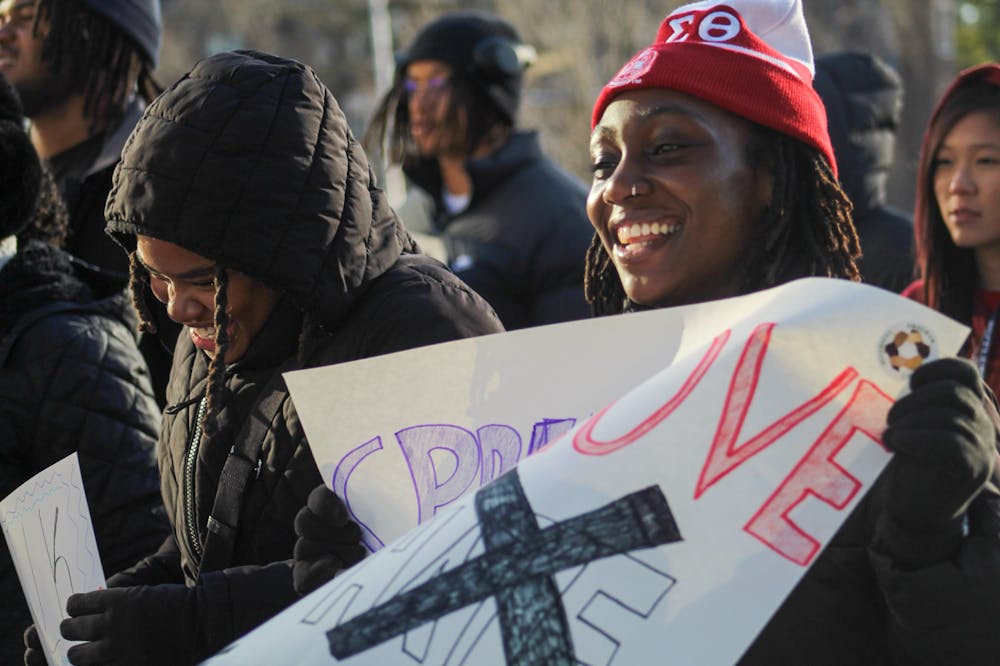
IU Indianapolis’ annual Martin Luther King Jr. Dinner, a campus tradition that has spanned nearly six decades, was cancelled this year, prompting frustration among students and leading a series of student-led events across Indianapolis on MLK Day.
The dinner, which would have marked its 57th year, has historically been co-organized by the university and the Black Student Union (BSU). According to BSU President Anira Joseph, the organization learned of the cancellation only after months of planning and repeated attempts to communicate with administrators.
“It was definitely a shock to see that the MLK Dinner was canceled, especially considering how long of a tradition it was for 57 years,” Joseph said.
Joseph, a senior studying public policy, said BSU typically begins planning the dinner nearly a year in advance. By the start of the fall semester, she said the organization believed the event was moving forward as usual.
“At the beginning of the academic year, we were told, ‘Yeah, we put down a down payment for the MLK Dinner,’ so we ran with that,” she said.
BSU is not responsible for managing the dinner’s finances, Joseph said, but trusted the information provided by administrators.
“We’re not [in charge of] our finances, so that’s the part that gets tricky,” she said. “We were told that, and so we ran with that because we trusted our leadership.”
Joseph said she and other student leaders repeatedly asked for planning meetings and confirmation throughout the semester but did not receive clear direction.
“We kept asking questions like, ‘Are we ever going to have a meeting about where it is? What’s going on?’” she said, describing BSU’s traditional role as sharing planning responsibilities with community partners.
The organization ultimately learned of the cancellation through a mass email sent Dec. 17, according to Joseph and a public statement later released by the BSU executive board.
The Campus Citizen contacted the Office of Student Involvement and the Division of Student Affairs for comment regarding the cancellation and timing of its communication. As of publication, neither office has responded.
Joseph said the lack of direct communication left student leaders to absorb the community’s reaction to a decision they did not make.
“There was nothing said by the university,” she said. “So I felt like it was our duty to share this with not just our students, but the community.”
She said the news arrived on a particularly difficult day.
“December 17th — my birthday — I get an email saying there will be no cultural dinners due to funding,” Joseph said.
Despite the cancellation, several students moved forward with alternative programming to mark the holiday.
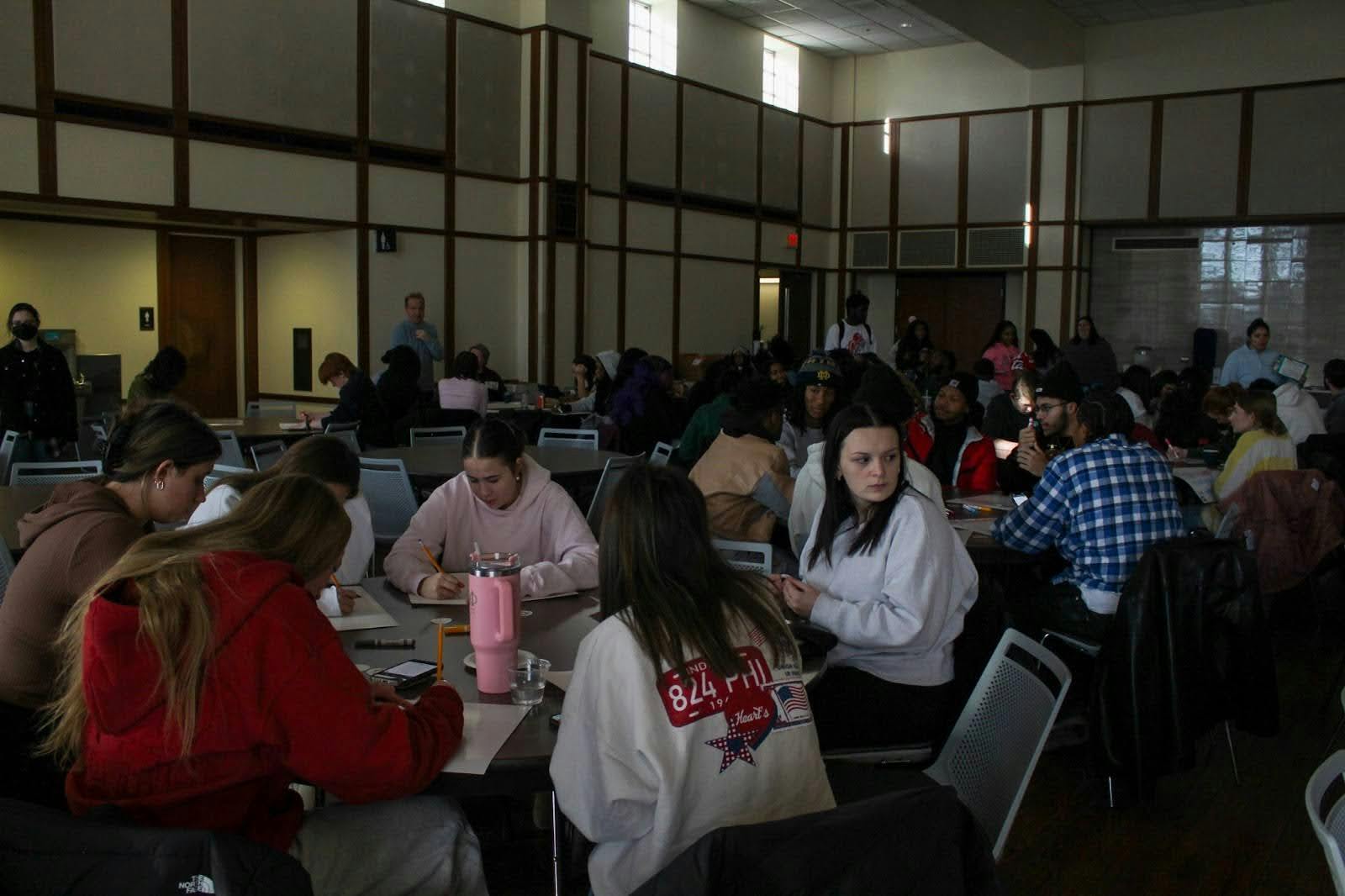
Some students organized additional demonstrations on campus, including an “eat-in” protest where participants gathered publicly to share a meal and discuss the decision. According to reporting by WFYI, at least two dozen students attended the demonstration, which was organized by senior Darrius Avery after learning the dinner would not take place.
Avery told WFYI the cancellation aligned with recent policy and funding changes affecting programs tied to marginalized communities and said the issue extended beyond a single event.
A faculty member who attended the protest also questioned the university’s justification, telling WFYI that no state or federal law prohibits hosting events honoring historical figures such as King.
Alexandria Edmonds, a senior majoring in social work with a minor in philanthropic studies, organized a community remembrance event Monday evening in Indianapolis. Edmonds said the decision came quickly after learning the university would not host the dinner and that no replacement event had been announced.
“I had been going to the MLK Dinner since I was in eighth grade,” Edmonds said. “It’s been a big part of every January — getting dressed up, going with your friends, seeing your community.”
Edmonds said the tradition extended beyond a single night.
“It was something you just knew you were going to do every year,” she said, recalling scholarship groups reversing tables and families attending together.
She said she decided to act when it became clear that no alternative programming would be offered.
“After 57 years, it’s just one of the last things you would think would be cut,” said Edmonds. “And there was nothing to make up for it.”
The event was organized in less than a week, she said, with students, performers and speakers volunteering their time. Joseph and several members of IU Indianapolis’ BSU attended.
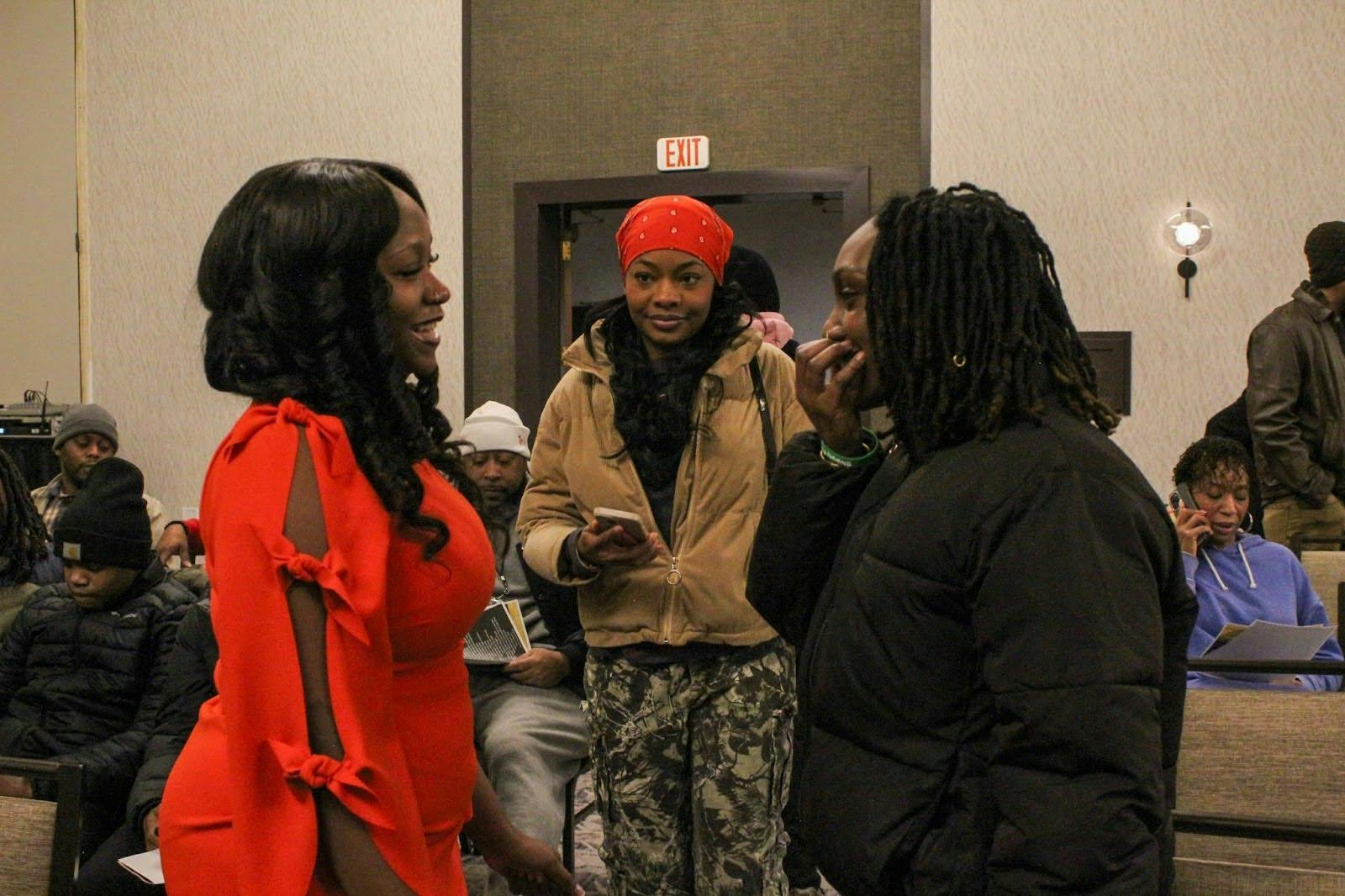
Joseph said student-led events like Edmonds’ demonstrate the importance of maintaining community spaces, even when institutional support is absent.
“It’s about the legacy of your identity, preserving our history, keeping the torch — the march on,” she said.
Earlier in the day, Joseph and other BSU members participated in the annual MLK Love Walk hosted by Butler University’s Black Student Union.
Butler BSU co-presidents Kendall Johnson and Edyn Curry said the walk was created more than a decade ago by faculty in collaboration with campus diversity organizations and has since grown into a multi-campus tradition.
“The MLK Love Walk was started by one of our professors in collaboration with our diversity program council, and BSU is part of that,” Johnson said.
Curry described the continued growth of the event as intentional and political.
“This is an act of active resistance that we are engaging in,” Curry said.
Johnson added that students traveled from across Indianapolis to attend, including from IU Indianapolis.
“People from IU Indy are coming here too,” she said.
Outside her formal role, one Butler BSU leader said the walk is meant to counter the political climate students are navigating.
“We are living in a time where empathy is almost the void… things feel very polarized, things feel very uncertain,” Johnson said. “What we want this love walk to do is provide Butler — and now IU — a sense of community… and give people some hope.”
Johnson and Curry said the walk has become a space for reflection, solidarity and political awareness across campuses.
“This is an act of active resistance that we are engaging in,” Curry said of the event’s continued growth.
Johnson added that students from multiple universities, including IU Indianapolis, attended.
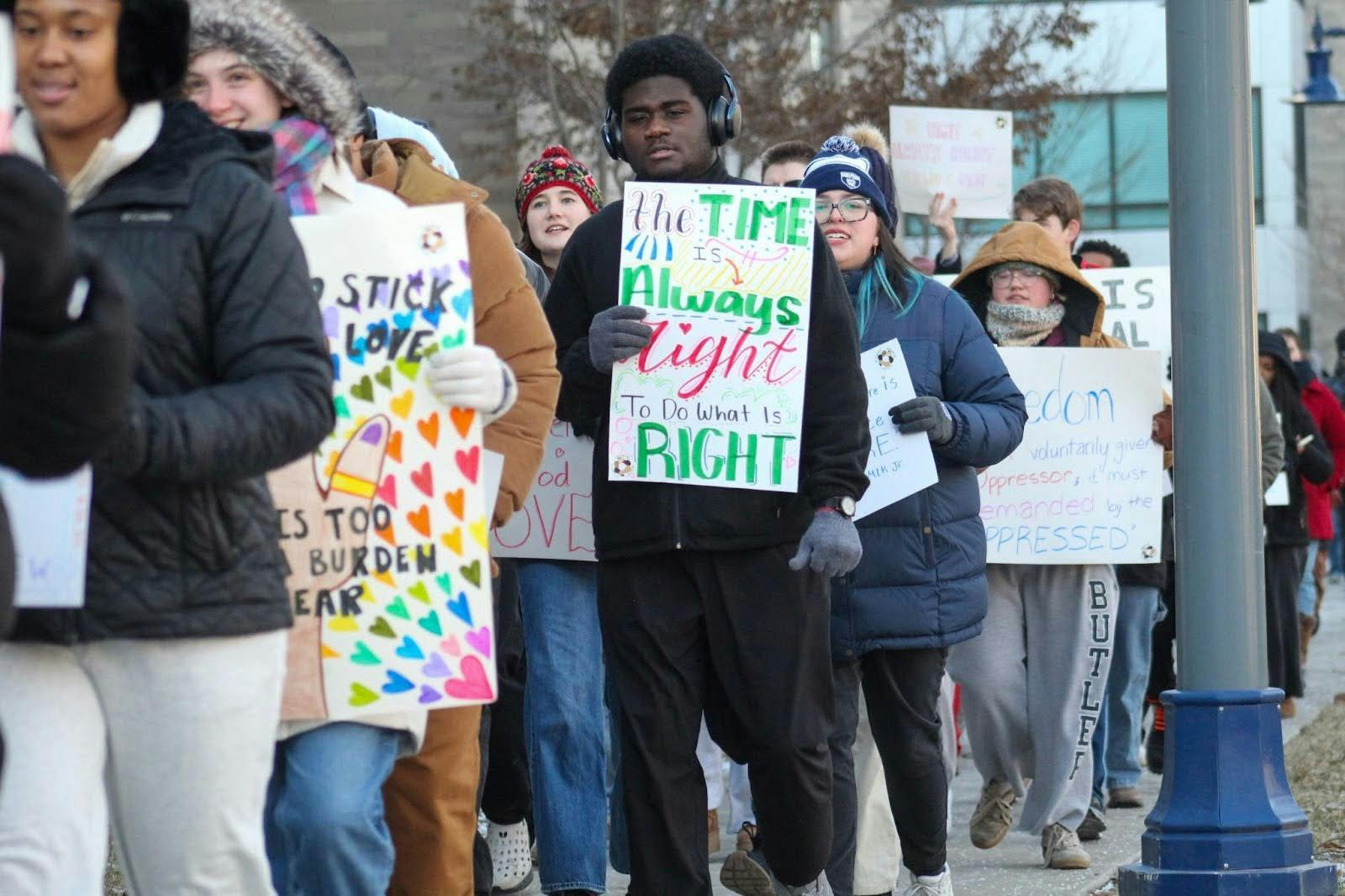
Studnets and community members of Butler University march at the MLK Love Walk, many holding posters with quotes of unity.
The walk commenced after remarks from keynote speaker Dr. Corey Reed, who centered his speech on civic courage and the cost of speaking out.
“I was tasked today with speaking about the value of raising our voices and what marching means in our contemporary context,” Reed said. “In order to do that well, I feel it necessary to remind us who King was, ideologically, and why his contribution matters to those of us across the political spectrum.”
Reed emphasized that King’s leadership was not widely accepted during his lifetime.
“King was unpopular until after his death,” Reed said, citing public opinion data showing his approval rating sat at 33% in 1966.
Joseph said IU Indianapolis’ BSU plans to host a town hall later this week to allow students to ask questions about the cancellation and to discuss next steps.
She said she hopes the university will respond publicly and take responsibility for how the decision was communicated.
“Take accountability,” Joseph said. “Really take accountability.”
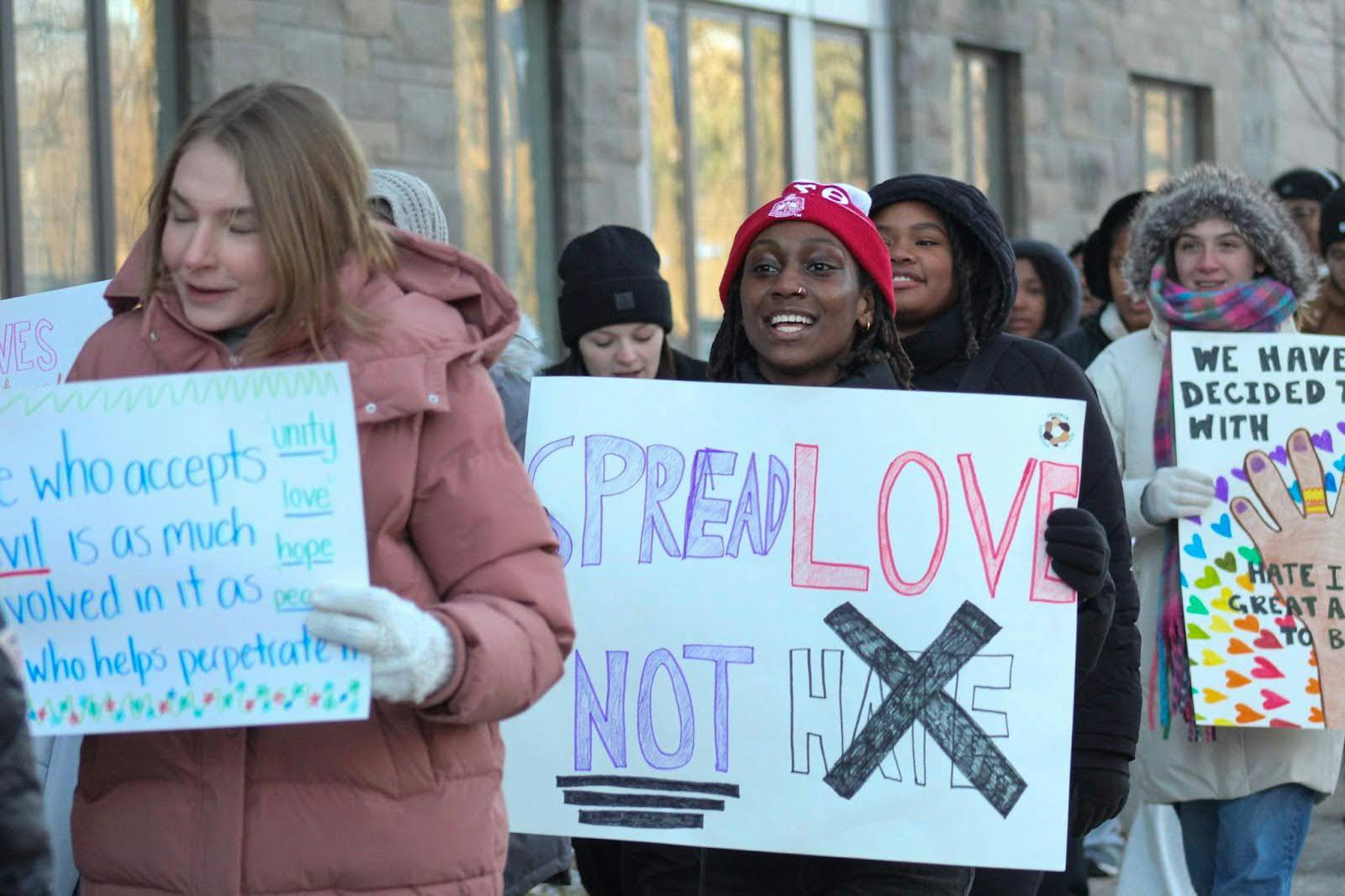
For now, she said, students are focused on maintaining community and honoring King’s legacy through their own efforts.
Together, the Love Walk, the remembrance event and student-led protests reflected a broader effort by students across Indianapolis to preserve traditions they say the university failed to protect.
Editor’s note: This story will be updated following the BSU town hall scheduled for Wednesday.
Salsabil F. Qaddoura is the campus editor, financial officer and co-social media editor of The Campus Citizen. She is an undergraduate student on a pre-law track with a minor in business. She is passionate about public service and volunteerism to better our communities and the world.

Troi Wharton had to learn how to walk again. Ten years later, she walked the Kelley graduation stage.
By Salsabil F. Qaddoura | May 31Troi Wharton remembers the first time people noticed she could not walk straight. It was 2016, and Pokémon Go had taken over the summer. Wharton, then 20, was playing the game around Indianapolis with friends and family. At the canal. At the zoo. Anywhere her phone told her another Pokémon might appear. The game required players to physically move through the real world. For Wharton, that meant walking more than usual. For the people around her, it meant seeing what she had not yet accepted.

Q&A Interview: IU Luddy Indy Media Arts Lecturer Albert William retires after 35 years
By Zachary Aigbe | May 24Albert William, a Media Arts (3D) faculty member at IU Indianapolis began working with IU in 1991 in the School of Medicine, later earning his New Media --- later called Media Arts --- degree in Dec. 2002, and joined then-IUPUI’s School of Informatics --- later called the Luddy School of Informatics, Computing, and Engineering, Indianapolis --- faculty shortly afterward in 2003. His long career spans 35 years with IU Indy, and specifically 23 years within Luddy; his beginnings with the school spanning even further back from his early involvement in the New Media program around its earliest days in 2000 – back when classes were first being offered at the school, as he was a Master’s student at the time. This makes him not only one of the longest-tenured Luddy faculty members, but also one of the last ones from the school’s earliest days as well, including his time as a student there. At the end of the 2025-26 academic year, William retired.

Collaborative mass casualty simulation takes learning beyond the classroom for IU medical students
April 25The dark night explodes with the cheers of thousands of fans as they flood the streets of downtown Bloomington to celebrate Indiana University’s College Football National Championship victory. Suddenly, this festive scene turns chaotic — someone has fallen from the upstairs balcony of the pub, another person is overcome by smoke inhalation from a burning vehicle, and a loud noise causes the crowd to stampede.
