
Editor’s Note: The article was originally published on Nov. 13 but was temporarily taken down and revised to correct misquotations and remove sensitive information.
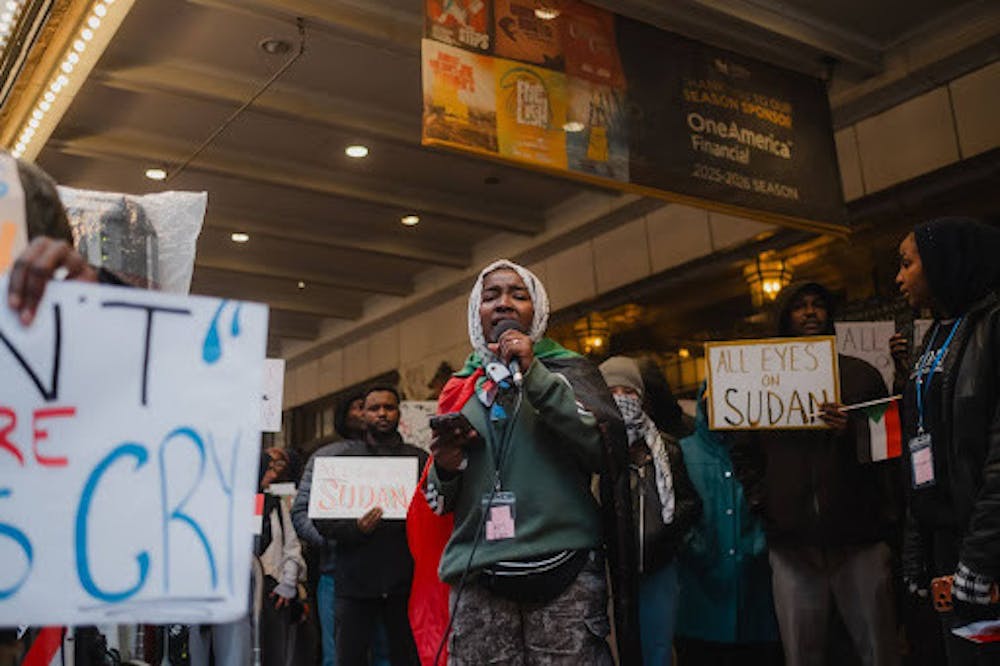
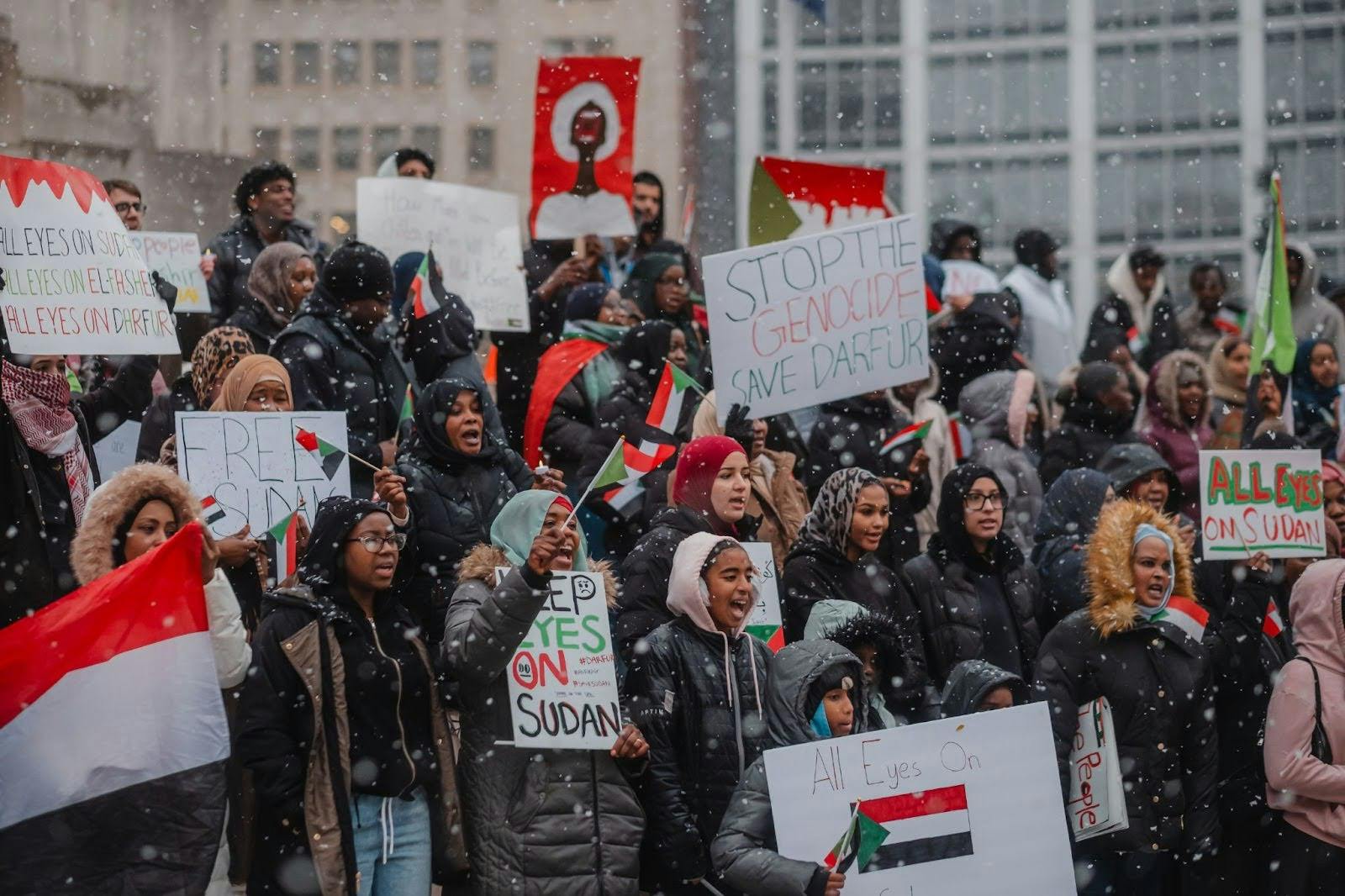
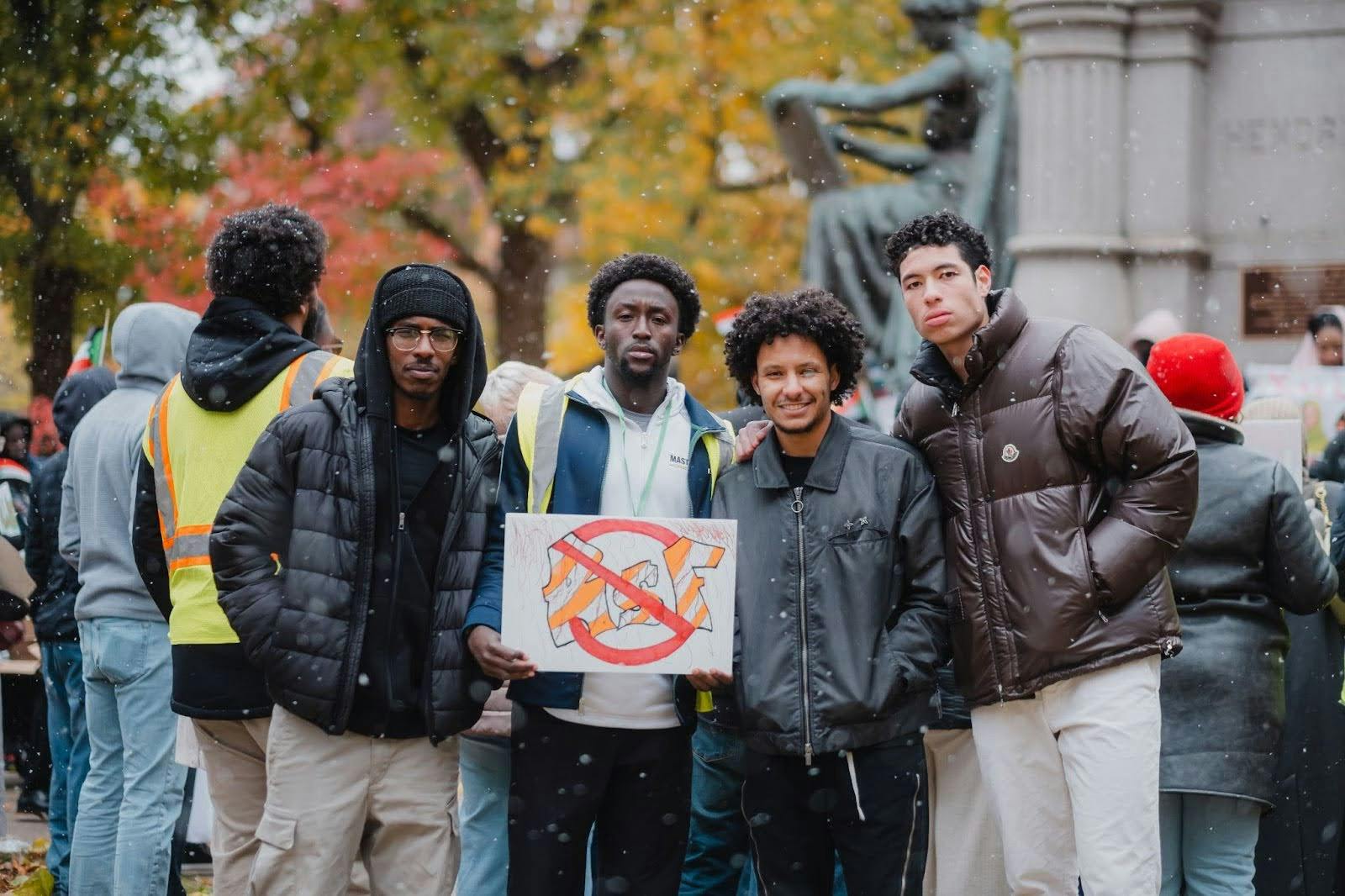
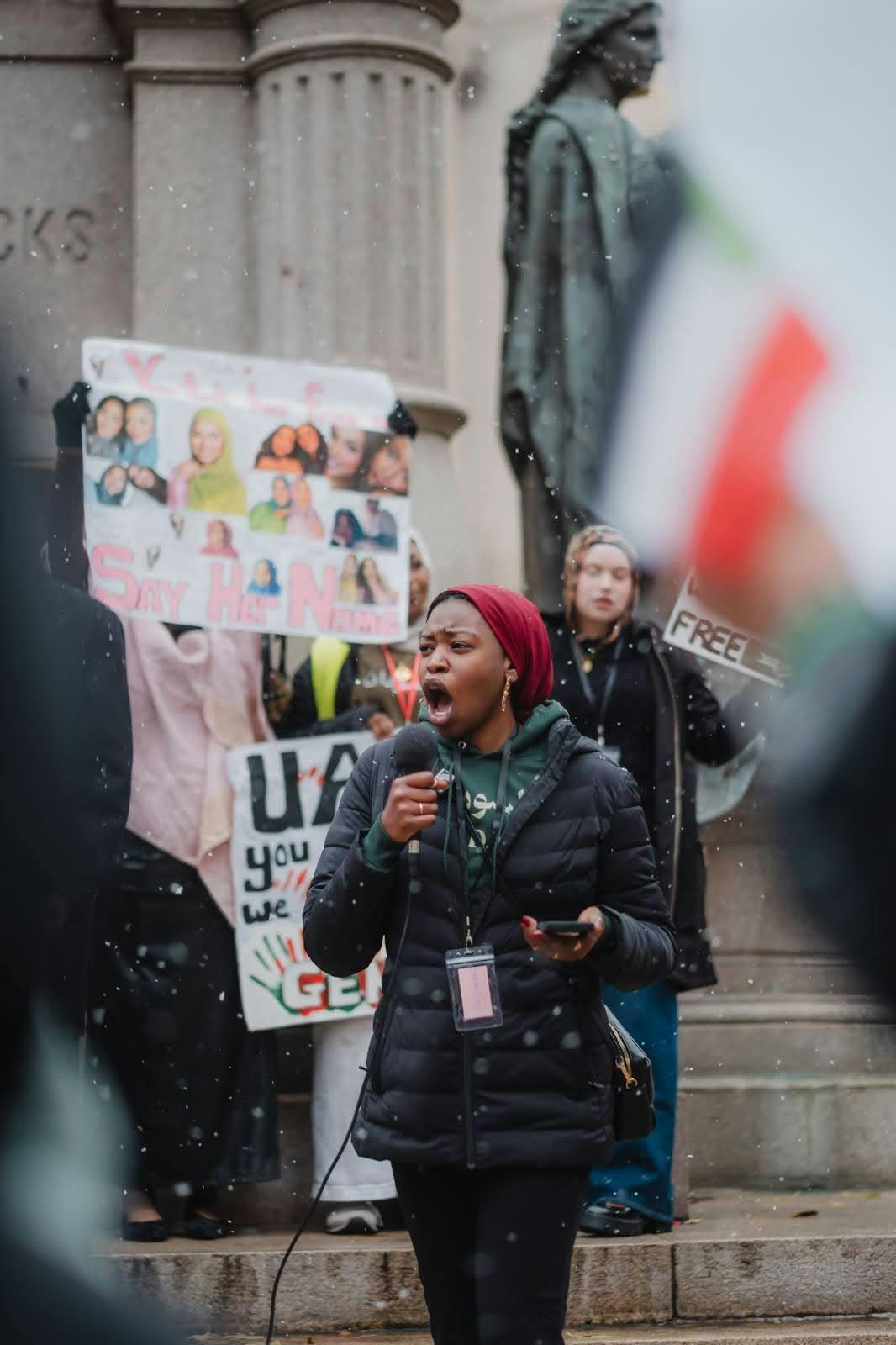
On Sunday, Nov. 9, in downtown Indianapolis, students, leaders and community members from across Indiana rallied for Sudan in the cold and snowy weather.
The day of action was led by the Darfur Diaspora Collective (DDC), a youth-led organization founded in Indianapolis to amplify the voices and concerns of the Darfur community, both locally and globally, to advocate for justice, transform public discourse and mobilize support.
They collaborated with various organizations across Indiana, including the Middle Eastern Student Association, and Chi Chapter of Delta Sigma Theta Sorority from IU Indianapolis, and the Ethiopian/Eritrean Student Association and African Student Association from Purdue in Indianapolis, among many others.
The day of action began with a panel discussion at the IU Indianapolis University Library, led by Sudanese community leaders across the U.S. Panelists included Yassmin Mohamed Fashir, Wamda Garo, Sheikh Ahmad El Alamine, Fadul Zakaria and Nadia Taha. They discussed the humanitarian crisis in Sudan and what Hoosiers can do to support the fight against the Rapid Support Forces (RSF) genocide in Sudan.
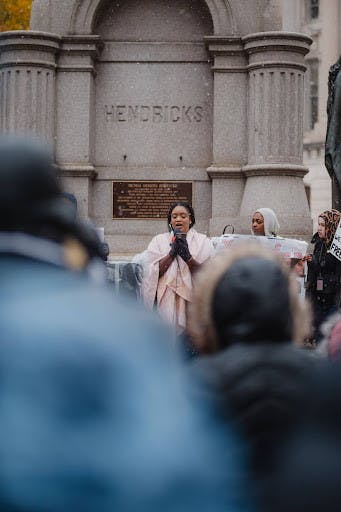
Afterwards, hundreds of community members marched to the Indiana Statehouse and Monument Circle, sharing chants like “Free free Sudan,” “Free the people, free the land” and “We demand a free Sudan.”
Members also shared their stories about people they have lost, what they have lost and motivational speeches to the Sudanese community in Indiana to continue fighting for peace in Sudan. The day ended with a candlelit vigil for Sudan.
One of the panelists, Wamda Garo, an international and humanitarian aid research professional and co-founder of the DDC, discusses how foreign influence in Sudan is increasing the impact of groups like the RSF.
“There have been reports of between 30% to 8 % of the Janjaweed no longer being made up of Sudanese people, and so a lot of those people are made up of people from neighboring countries like Chad, mercenaries from Libya and the United Arab Emirates (UAE). You have most of this army going in and committing genocide in Darfur. It’s not really a civil war anymore; it's not an even battlefield between these two groups anymore in Sudan. People outside of the country are coming in and cleansing Sudan with some of the latest technology that countries like the UAE are funding,” says Garo.
Yassmin Mohamed Fashir, who works for the Monitoring and Reporting Association and is a co-founder of the DDC, adds that there needs to be pressure on the UAE to stop backing the RSF.
Garo mentioned that earlier this year, “there was a bill that was drafted by some congressional members to sanction the UAE until there was proof of an arms embargo, until there was proof that they were no longer funding the RSF.”
Garo adds that the UAE has reportedly been giving humanitarian aid to a camp near Al-Fashir.
“However, the problem is that you cannot give food to people if people can’t get there in the first place. You can’t give food to people if they’ve already died in their home city. And there is no point in starving people and then wanting to give food to them if they’re fleeing that country,” said Garo.
The solution to this problem, most panelists relay, is that foreign intervention must stop in Sudan. Fadul Zakaria, the founder of Democracy and Human Rights for Africa Corp, highlights this.
“It’s not really the job of the U.S. or any European country to impose a form of democracy because that's the biggest mistake they make in Africa. They want to impose capitalism. They want the separation of religion. The [current issue] right now is that it is the job of the Sudanese people. They decide the form of democracy they want. I think the biggest thing they want right now is to stop foreign interference,” said Zakaria.
One of the events that pushed the DDC to organize the Day of Action is the recent event in the city of El-Fasher in Sudan, where the RSF captured the city and has been reportedly massacring Sudanese people.
In El-Fasher, the situation has gotten worse for the Sudanese people.
“There has been satellite proof published by the Yale School of Public Health that has been above El-Fasher tracking the genocide. There are photos of blood being visible from these satellites,” said Garo.
The attacks by the RSF have affected millions of Sudanese, such as panelist Nadia Taha, a media reporter and producer at Voice of America and the World Bank, who describes the situation in El-Fasher as devastating.
“I lost so many family members, including my own brother, months ago. So this will tell you how difficult this situation is in El-Fasher,” said Taha.
Sheikh Ahmed El Alamine, the Director of the Indianapolis Muslim Community Association (IMCA) and Board Chair of the Center for Interfaith Cooperation, shares what Hoosiers can do to support the Sudanese cause.
“No human being deserves what is going on, but definitely Sudanese [people] do not deserve what is going on. I would like to invite you first as a human being, and as a person of principle, to first create awareness about this [Sudan Conflict]. Second, I am a person of faith, and regardless of one's faith, prayer absolutely does work. Third, I tell the elderly to get out of the youths' way, let them do the work. We need the wisdom of the elderly but the energy of the youth.”
Fashir discusses a traditional system of justice in Sudan that an audience member brought up. It is called the Judiya system, which translates to generosity. The Judiya system refers to a local justice system primarily used for resolving interpersonal or intertribal disputes related to land and resources.
“When someone does something wrong, they pay retribution or they fix the situation. They break a candle, they fix it or they pay for it. In the United States, if you steal something, you get put in prison. So it’s a different type of justice system that is happening,” said Fashir.
Fashir points out that the United States and other foreign powers don’t rely on the Judiyas system because it doesn’t look like the Western legal framework.
“The situation is not fixed. All the infrastructure is gone, the markets are closed, and there’s no food. All the systems, all of these houses have been burnt down, and people have died. So what there needs to be is retribution, a system where they’re [Sudanese people] able to go back to their land and be able to rebuild. And I think that is exactly how justice should look like, and that’s exactly what the Judiyas framework is pushing for.
For more information on the conflict in Sudan, visit this link for credible resources and organizations to learn from and support through donations.
If you’re interested in signing petitions, visit the Darfur Diaspora Collective on Instagram to view petition links.
All sources and information were received from the Darfur Diaspora Collective.
Oumou Sow is a second-year student at IU Indianapolis, majoring in political science with minors in international studies and legal studies. She loves to read fantasy books, binge-watch Marvel movies, and listen to political and educational podcasts.
18 years in, Carson faces real challenge: What Wells and Hornedo would do for IU Indianapolis students
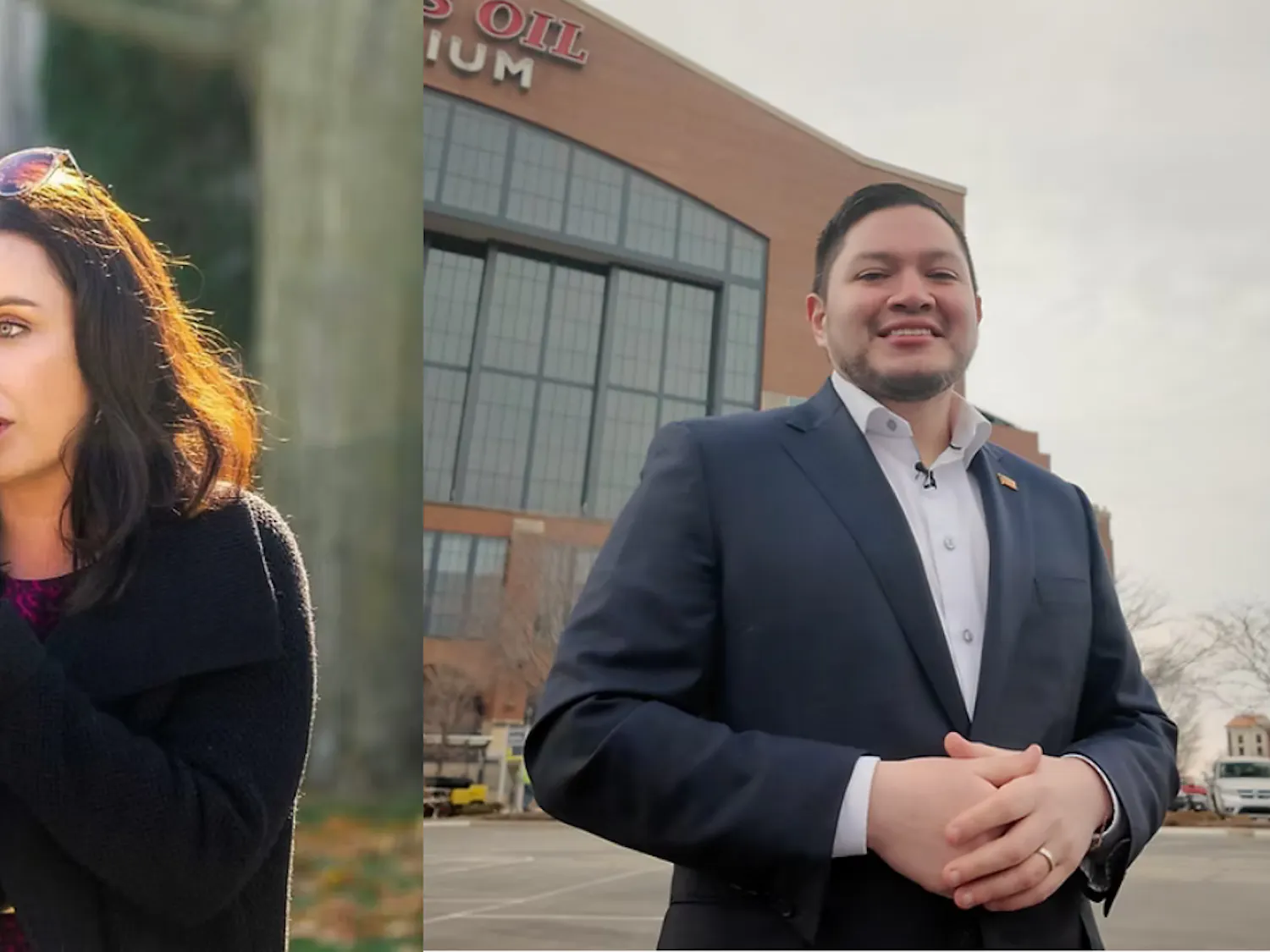
By Thomas Garvey | April 21On May 5, 2026, Indiana's 7th Congressional District will hold its most competitive Democratic primary in years. André Carson, an 18-year incumbent, is facing a real challenge for the first time since his 2008 victory. District 7 — which encompasses IU Indianapolis's campus — is a reliably safe Democratic house seat, meaning the primary winner will likely go on to represent the district in Washington. The Campus Citizen spoke with two of the leading Democratic challengers: Destiny Wells and George Hornedo. Wells comes in with a military background, having served in Afghanistan and now serving as a lieutenant colonel in military intelligence. Wells is an IU alumna and earned her law degree from the University of Texas in 2011.
Dozens gather at Monument Circle to protest immigration enforcement, joining statewide student movement
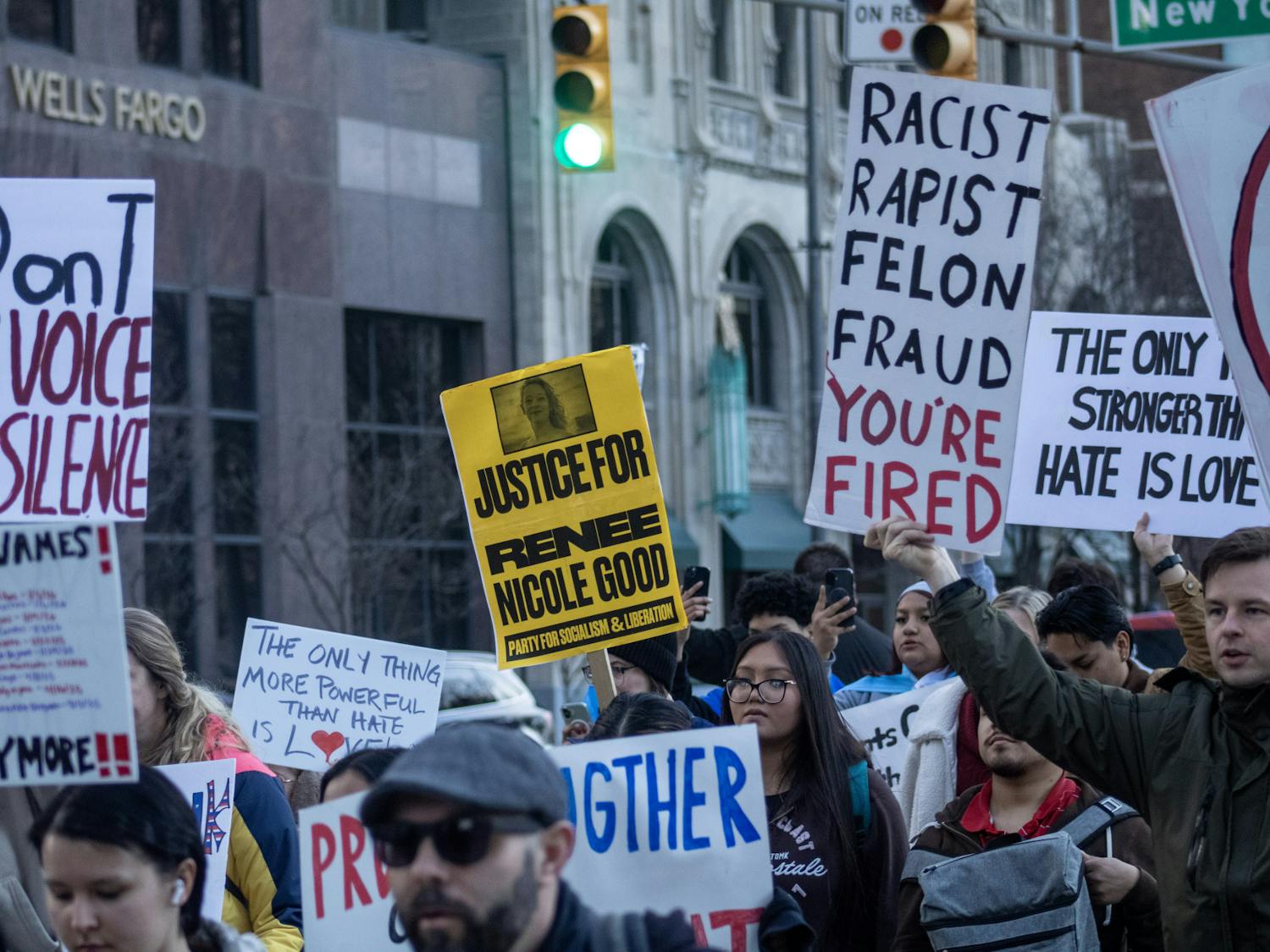
By Salsabil F. Qaddoura | Feb. 14A crowd of protesters gathered Friday evening at Monument Circle to demonstrate against U.S. Immigration and Customs Enforcement and federal immigration enforcement policies, joining a wave of student-led protests taking place across Indiana and across the country.

Mid-session recap: Indiana legislature advances bills affecting IU Indianapolis students
By Salsabil F. Qaddoura | Feb. 13As the Indiana General Assembly moves past the midpoint of its 2026 legislative session, lawmakers are advancing several bills that could directly affect Indiana University Indianapolis students, including legislation impacting university governance, state funding, faculty oversight and academic programs.
