
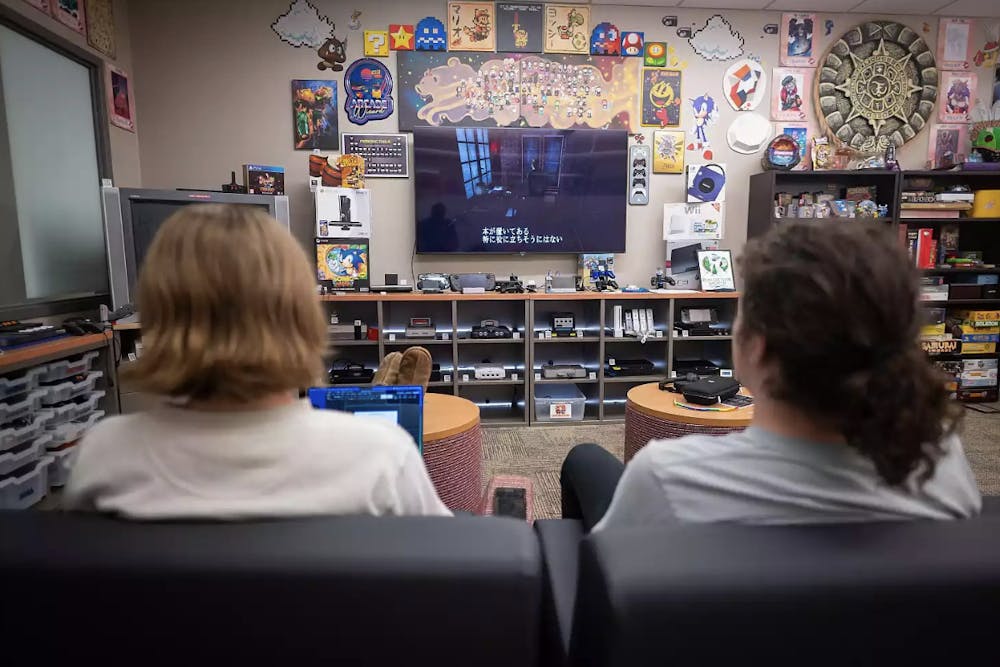
Created in 2009, the Media Arts Research Learning Arcade, also known as MARLA, has grown from an empty room into one of IU Luddy Indianapolis’ most distinctive, creative spaces. Today, it functions as a hybrid: part collaborative lab, part social “third space” and part officially recognized IU Museum Collection dedicated to preserving video game history.
For Mathew Powers, a longtime lecturer in the Media Arts and Science program in Human-Centered Computing (HCC), MARLA’s beginnings trace back to a simple realization early in his now 19-year career.
“Back when I started teaching here, we realized we didn’t have a third space for people,” Powers said. “There wasn’t really a dedicated space for people who could make games and do animation and really work on their stuff.”
Everything changed one day when he noticed an unused fourth-floor room.
“There was nothing in there but a chair, a Johnny box — which is a stereoscopic machine — a big piece of wood and a table,” Powers said.
He immediately saw its potential: This could become the space students were missing — a place to create, collaborate and belong.
Powers worked with colleagues to form what would become the MARLA council, a group of faculty, students and staff that he says works really hard for the sake of MARLA. With their support, the team secured a $25,000 grant from the Center for Teaching and Learning. That funding transformed the bare room into a functional lab, complete with new desks, furniture and powerful computers.
MARLA has changed over the years, but its purpose hasn’t. It was intentionally built as a third space: one that wasn’t a classroom or an office, but a home base for Media Arts students.
The biggest challenge early on was equipment.
“The hardest part was just getting the right computers,” Powers said. “We bought a bunch of really strong computers, and we got two giant AlienWare computers — which was really fun because they would overheat and then their plates would open up and make a hissing noise.”
Workstations and a TV followed. Students could gather, plug in consoles and spend time playing video games together.
“We put a TV in there, so people could actually hook up games and do research as we say – which means playing the games,” Powers said.
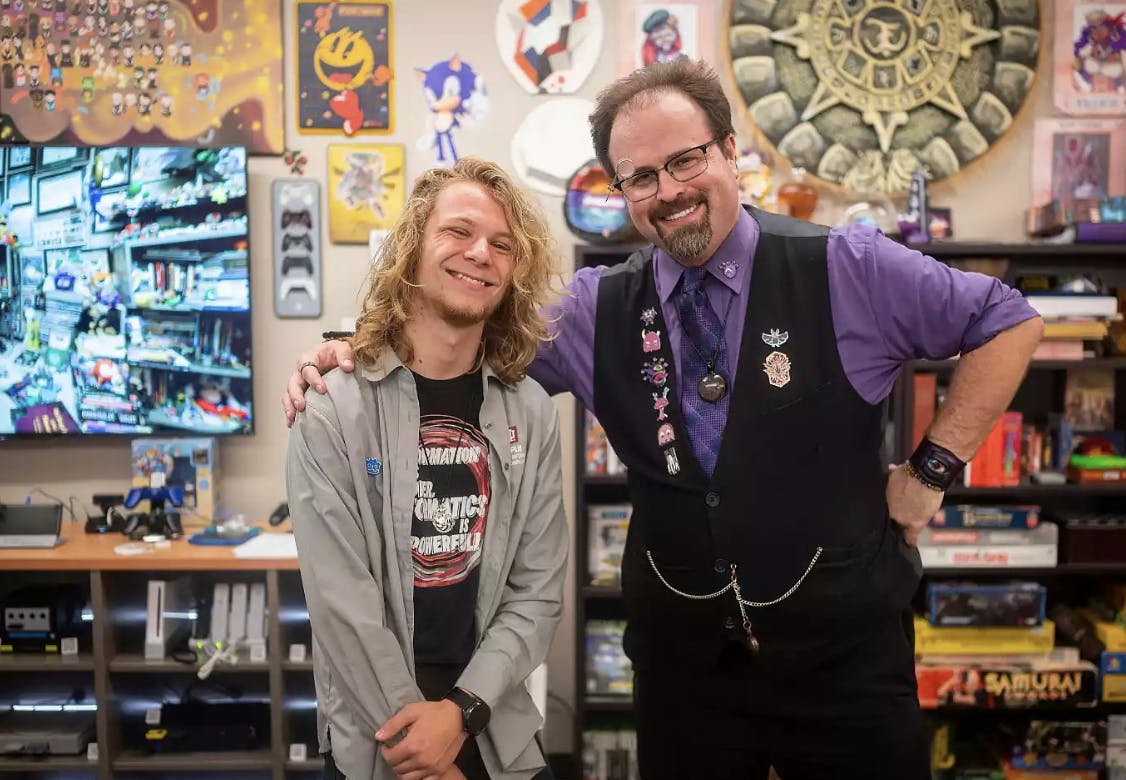
Over time, MARLA expanded. It moved from its original 500-square-foot room to a 1,000-square-foot space on the other side of the building. The walls are filled with student work, game memorabilia and artifacts from MARLA’s growing archive. It became a place where student-led groups — like LORE Club, founded by Media Arts student and MARLA-lead student worker Haven Hamelin — could meet to discuss games, storytelling and digital culture.
“MARLA has expanded beyond my wildest dreams,” Powers said. “She moved, she’s gotten bigger — she’s just really blossomed into her own little identity and her own special place in the building.”
A second $25,000 grant later supported updated equipment and furniture as the space continued to evolve. But MARLA’s largest milestone came recently: Its official rededication as an IU Museum Collection.
With museum status came a broader mission.
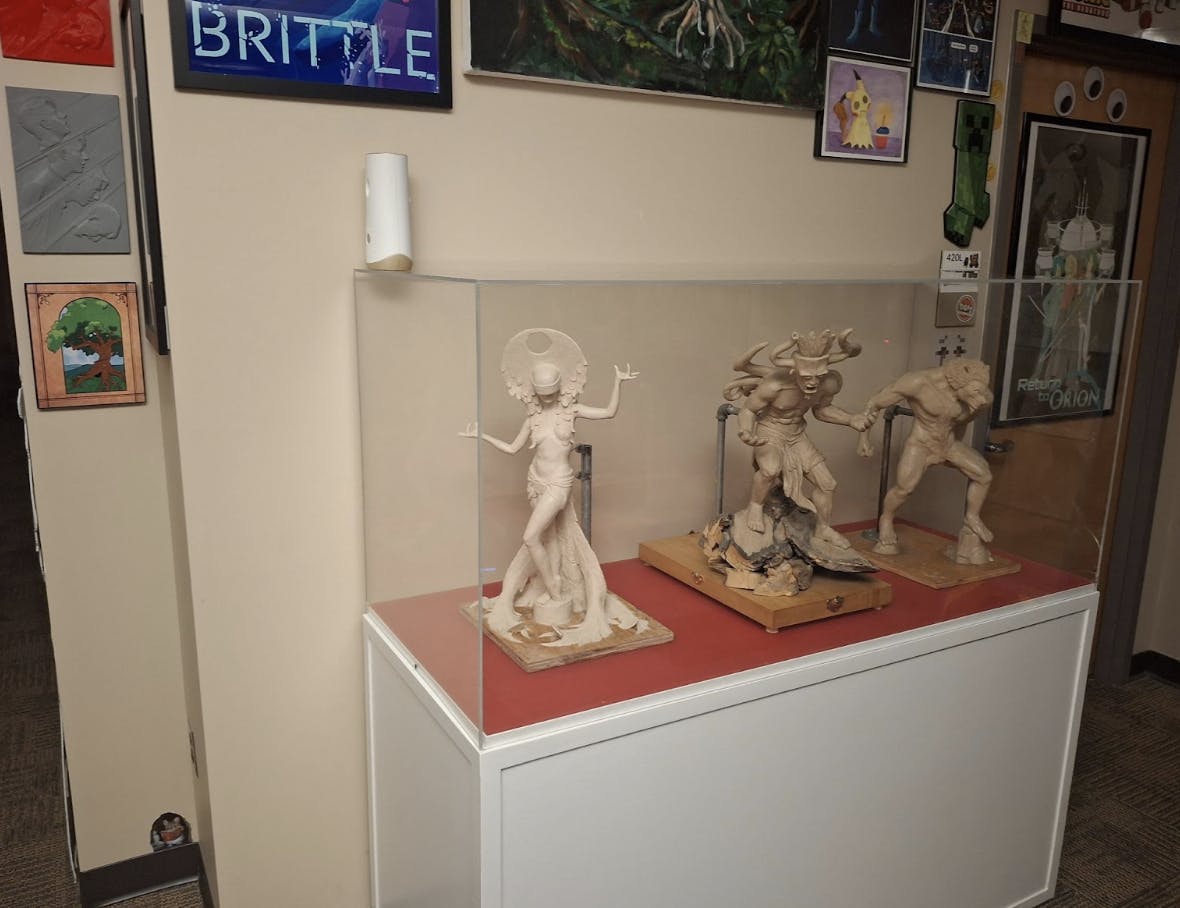
“We’re trying to preserve three areas,” Powers said. “We’re trying to preserve games through the ROM [Replayable Object Menagerie] collection, we’re trying to preserve student work and we’re also trying to preserve creature work [as part of the ‘Cosmic Wonder Creature Design Collection’].”
The creature collection is supported in part by a $50,000 anonymous donor.
Andrew Borman, chief digital preservationist at the Strong Museum of Play, visited the IT building to speak on the importance of digital and interactive media preservation after MARLA was invited to present at the “Save the Games” symposium in August 2024.
Through it all, Powers emphasizes that MARLA’s growth has never been about one person.
“MARLA really works because we have a MARLA council,” Powers said. “Everybody works really hard for the sake of MARLA.”
While Powers helps shape the big-picture vision, the day-to-day life of MARLA is maintained by student workers — most notably Haven Hamelin and Sam Barks, a fellow Media Arts and Sciences student who graduated in Dec. 2025. Hamelin is the lead student worker responsible for cataloging, organization and managing donations.
Hamelin’s description of a typical workday starts with a disclaimer.
“Well, the funny thing with MARLA is that there is no such thing as typical,” said Hamelin.
On scheduled work days, Hamelin heads to the small office behind MARLA — nicknamed “The Backrooms” — to assess the day’s needs.
“Sometimes, it’s very specific,” he said.
Preparations might include getting the space event-ready or doing a deep clean. Other days might involve reviewing donation backlogs.
“There’s more than 2,000 games I have to go back through — and not just games, right? But that’s the number everyone likes to hear,” Hamelin said.
Early on, MARLA had no standardized donation system. Hamelin helped develop a more structured system for processing donations over time, which now requires retroactively recataloging years of student and community contributions.
“The final result is having our students be able to experience games of the past in a social environment, where they can also share ideas and maybe make games themselves,” said Hamelin.
Working at MARLA has also pushed Hamelin to grow professionally. He describes how coordinating projects, managing priorities and communicating across departments taught him skills he’ll use long after college.
“Once you actually get put to the test you end up flailing a little bit,” he said.
MARLA forced him to prioritize effectively, solve problems quickly and recognize when small tasks were getting in the way of larger goals. Those skills, Hamelin said, apply anywhere from start-ups to large studios.
Equally important has been learning how to work within a team.
“Becoming comfortable being one of another colleague’s co-workers, people in a shared space trying to get work done,” Hamelin said.
There’s one word both Powers and Hamelin use to describe MARLA: Sanctuary.
“People are excited to be there, and I think it’s beautiful,” Hamelin said. “Sometimes people aren’t even there for a specific purpose; they just come in just because it’s a third place: somewhere away from work, away from home,” Hamelin said.
This relaxed, welcoming energy has helped MARLA develop a strong community identity. Conversations flow easily as students drop in to socialize, eat lunch or contribute to the space.
For Powers, the moment he realized MARLA had become something meaningful had nothing to do with grants or equipment. It was the students.
“The students love to sit in here, they love to play games, they love to work, they love to work together,” he said. “That’s how I know she’s working.”
More than 15 years after its creation, MARLA continues to evolve, expanding its archives and building community while serving as a bridge between the history and future of digital media. It remains a space built by and for students, shaped as much by their enthusiasm alongside the faculty and staff who maintain it.
For those who helped build it and those who now help run it, MARLA remains exactly what it was always meant to be: A home for creativity, collaboration and community at IU Indianapolis’ Luddy School of Informatics.
Zach Aigbe is a writer for The Campus Citizen. Zach graduated in Dec. 2025 with a major in media arts and sciences, specializing in game design and development. In his spare time, he enjoys driving around the city, playing video games, watching TV and spending time with family.

Troi Wharton had to learn how to walk again. Ten years later, she walked the Kelley graduation stage.
By Salsabil F. Qaddoura | May 31Troi Wharton remembers the first time people noticed she could not walk straight. It was 2016, and Pokémon Go had taken over the summer. Wharton, then 20, was playing the game around Indianapolis with friends and family. At the canal. At the zoo. Anywhere her phone told her another Pokémon might appear. The game required players to physically move through the real world. For Wharton, that meant walking more than usual. For the people around her, it meant seeing what she had not yet accepted.

Q&A Interview: IU Luddy Indy Media Arts Lecturer Albert William retires after 35 years
By Zachary Aigbe | May 24Albert William, a Media Arts (3D) faculty member at IU Indianapolis began working with IU in 1991 in the School of Medicine, later earning his New Media --- later called Media Arts --- degree in Dec. 2002, and joined then-IUPUI’s School of Informatics --- later called the Luddy School of Informatics, Computing, and Engineering, Indianapolis --- faculty shortly afterward in 2003. His long career spans 35 years with IU Indy, and specifically 23 years within Luddy; his beginnings with the school spanning even further back from his early involvement in the New Media program around its earliest days in 2000 – back when classes were first being offered at the school, as he was a Master’s student at the time. This makes him not only one of the longest-tenured Luddy faculty members, but also one of the last ones from the school’s earliest days as well, including his time as a student there. At the end of the 2025-26 academic year, William retired.

Collaborative mass casualty simulation takes learning beyond the classroom for IU medical students
April 25The dark night explodes with the cheers of thousands of fans as they flood the streets of downtown Bloomington to celebrate Indiana University’s College Football National Championship victory. Suddenly, this festive scene turns chaotic — someone has fallen from the upstairs balcony of the pub, another person is overcome by smoke inhalation from a burning vehicle, and a loud noise causes the crowd to stampede.
