
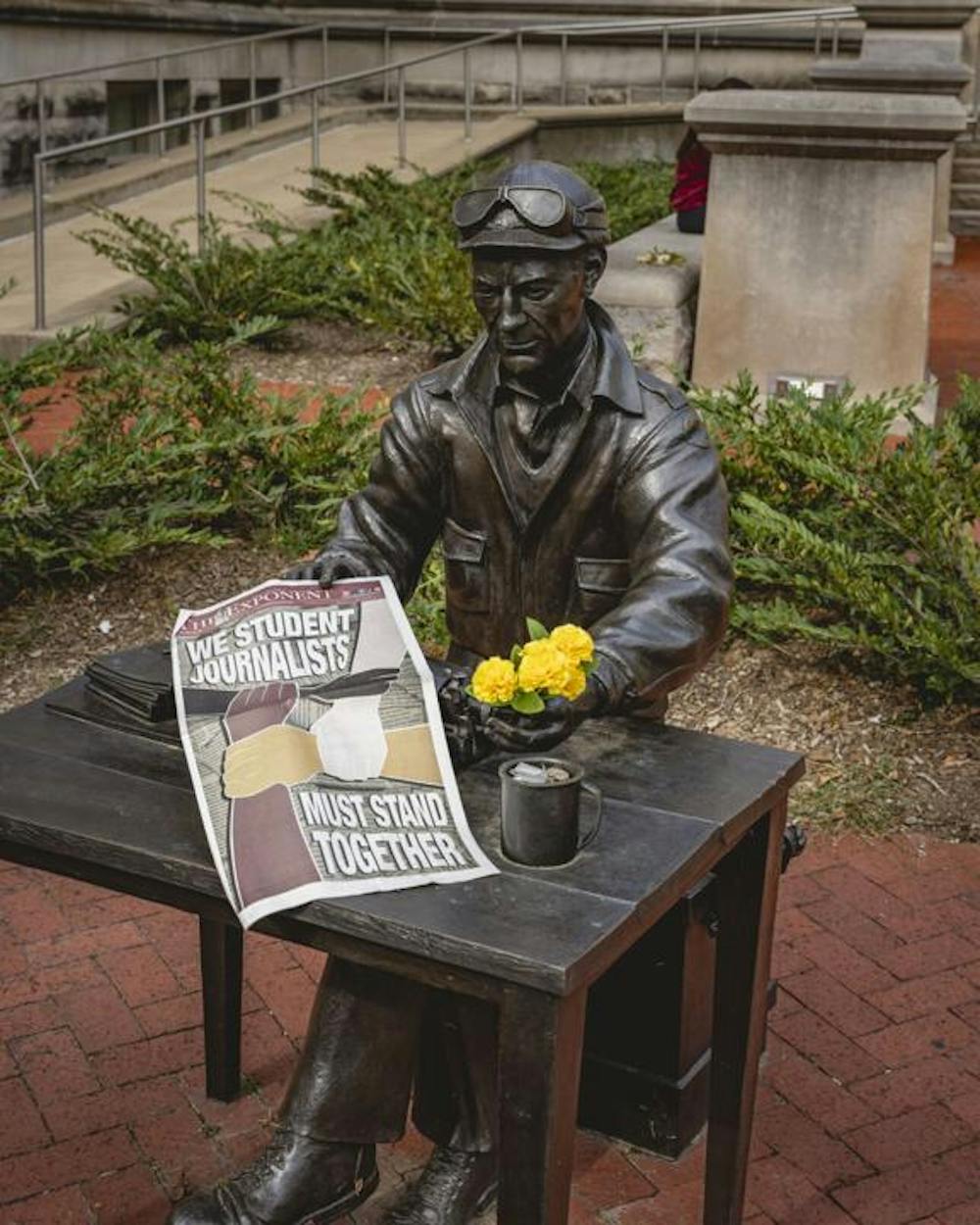
Editor's Note: This article was originally published by The Exponent, Purdue West Lafayette's student publication.
By Olivia Mapes (Editor-in-Chief)
Indiana University reversed course Thursday to once again let the Indiana Daily Student print special editions of the newspaper. The decision came just hours after Jim Rodenbush, the former director of the paper who had gotten fired because he allegedly refused to censor the paper, filed a lawsuit against the university for wrongful termination.
Rodenbush, who had been the media director for eight years, filed a lawsuit in the Southern District of Indiana that seeks reinstatement to his job and monetary damages after he was fired Oct. 14.
“In a direct assault on the rights guaranteed by the First Amendment, IU fired James Rodenbush when he refused the directive to censor student work in the campus newspaper and print only fluff pieces about the upcoming homecoming festivities,” the complaint reads.
As the student media director of the IDS, Rodenbush said his job was often as a go-between for the media school and the student editors. Normally these conversations were built around advice or ideas, until the university sent him a directive to not put news in the upcoming Homecoming special edition and future printed editions.
“Nothing ever felt like an order until this one,” Rodenbush said.
He said there were no specific articles he could think of that would lead the university to want to censor the paper. He did have a feeling something more was coming, but he thought the university would pressure him, not fully fire him.
“They went right for the nuclear option,” Rodenbush said. “I was shocked but not surprised.”
The university asked for the IDS to create two versions of the homecoming edition — one without any news that would be distributed on campus and one with news that could be distributed around Bloomington.
The decision didn’t make sense financially since printing multiple versions would mean the printing press would have to do two separate runs, doubling the price, Rodenbush said.
The university then cut the IDS’ print entirely, framing it as a cost-saving measure similar to its decision to stop having weekly print last year.
“IU is in their rights to make budget decisions, but that decision has to be content neutral,” Rodenbush said.
IDS now to be printed
The editors of the IDS found out they could print again in a letter from IU Chancellor Dave Reingold.
“(I have) authorized the financial office to allow the IDS, under the supervision of The Media School, to use their established budget through June 30, 2026, as the editors see fit—so long as they remain true to their budgetary parameters,” the letter read.
This was a big win for student journalism, but more needs to be done, said IDS Co-Editor-In-Chief Andrew Miller.
“What is really at stake here is the editorial independence. I think it’s an important step that they're letting us print our special edition as we did all of last semester without controls on it,” Miller said.
Many within the Media School were not involved in discussions about changes to the IDS and felt betrayed by the university after only finding out through the news that Rodenbush was fired.
“Our conversations with administrators in recent days have led to disappointing outcomes: No public apologies, no acknowledgement of mistakes, no satisfactory explanation for the decisions they made,” a letter to the editor signed by 48 faculty members said.
“I recognize and accept that the campus has not handled recent decisions as well as we should have,” the letter from Reingold said.
Still, the students and the media school are unsettled.
“Yeah we got our print back, (but) Jim Rodenbush is still fired and they could fire other professional staff members and faculty members if they stand up for us,” said Co-Editor-In-Chief Mia Hilkowitz.
Attention from across the country has come to IU after the decision, putting pressure on the university. $1 million-plus in alumni donations were reportedly pulled from the university after the news came out, according to the IndyStar.
“They might overstep, but anytime they overstep they should expect swift backlash and people across the country would fight back against it,” Hilkowitz said.
While the changes have been reversed, there will be lasting impacts on the Media School. Along with withdrawn alumni donations, national attention during admissions season means there might be less applicants to the school, Hilkowitz said.
The editors also wish to be part of talks on what the university will do with the IDS moving forward, as their input has been left out through the firing of Rodenbush and cutting of print.
“These decisions have come from the top down at IU,” Rodenbush said. “When print was first cut back, students at the paper said they were not a part of discussions, and now they still haven’t been a part of discussions.”
The editors also want the university to listen to past and current committee recommendations.
“A committee of students, faculty, staff and alumni submitted new recommendations for restructuring student media in spring 2024. Many of that report's recommendations have not been followed up on. We don’t intend for this to happen again,” an IDS editorial from Thursday said.
The committee advised the school to stop looking at student media as a business, Rodenbush said.
“You don’t ask the biology school to turn a profit,” he said.
Many of the directives from the university have hinged on the fact that the IDS is not financially sustainable, but the job of the IDS is to teach students journalism and inform the community, which it has been doing, Miller said.
Beyond that, the IDS has been doubling its views on its website, he said.
The school has had opportunities to fund the IDS, specifically from mandatory student fees. This fund, which takes a certain portion out of money spent on tuition, was approved by a student-run committee and sent all the way to the provost, Hilkowitz said.
IU Provost Rahul Shrivastav rejected a student board’s vote to fund the IDS, according to a letter the IDS received June 5.
The mandatory student fees were expected to rise, but in order to keep tuition frozen they stayed stagnant. Shrivastav cited this as a reason for the rejection, and the student recommendation board adjusted the amount the IDS was asking for. Still, the funds were rejected.
The IDS has also gotten plenty of money in donations, specifically from Mark Cuban, a major donor who was disappointed at the censorship of the paper.
According to an article from the IndyStar, Rodenbush said they were not able to use money given to the IDS fully.
“If they really say it’s business, let’s do business. Give us the money,” Hilkowitz said.
Now, the school has implemented another committee to study editorial independence of the paper.
“It is peak gaslighting. You don’t need to study editorial independence, just let them have it,” Rodenbush said.
Eyes across the country are on IU, and the editors and Rodenbush want to keep attention on the situation.
“Everyon needs to pay attention. We have a giant country problem, not just an IDS problem,” Rodenbush said. “The decision (to reinstate print) yesterday shows that we have an impact.”
Letter with over 300 signatures demands reported ban of international students to end
March 3A total of 337 students, faculty and staff members have signed an open letter that was sent to the Purdue University Board of Trustees demanding that they end the reported ban on international students.

OPINION: Should Chiang stay? Or should Chiang go?
Feb. 25Last week Purdue faculty wrote a letter calling for Provost Patrick Wolfe’s resignation. The letter presented a slurry of justified condemnations and concerns mixed all together with rage as a binding agent. I’m with the faculty. I hate to see the things they list at my university — everything from a lack of deans to losing large government grants to overall discrimination, censorship, and secrecy.

Purdue in Indianapolis tries to embody spirit of West Lafayette campus
Nov. 11It’s hard to imagine starting a fresh university without much recognition. This is being seen in Purdue in Indianapolis, with questions on whether the spirit of Purdue is similar to that in West Lafayette.
