
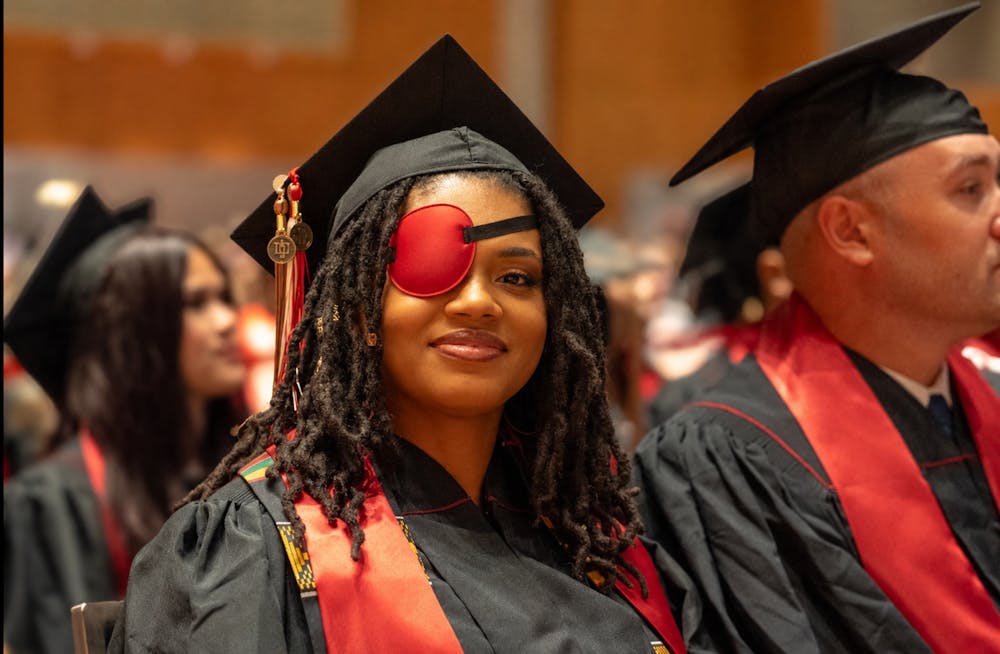
Troi Wharton remembers the first time people noticed she could not walk straight.
It was 2016, and Pokémon Go had taken over the summer. Wharton, then 20, was playing the game around Indianapolis with friends and family. At the canal. At the zoo. Anywhere her phone told her another Pokémon might appear.
The game required players to physically move through the real world. For Wharton, that meant walking more than usual. For the people around her, it meant seeing what she had not yet accepted.

She was veering. Stumbling. Losing her balance.
“I guess I see myself every day, and I didn’t notice that until people started, like, audibly saying, ‘Hey, are you OK?’” Wharton said. “And I would be like, ‘Yeah, I mean, it’s just my sandals or something.’”
It was not her sandals.
Months earlier, Wharton had been a college student at Ivy Tech Community College, still deciding what she wanted her future to look like. She had graduated from Hamilton Southeastern High School in 2014 after spending her freshman year at North Central High School in Indianapolis. She described herself as a decent student, but not a straight-A student — someone more interested in running track and being social than obsessing over assignments.
After high school, she applied to several IU campuses. She applied late, and her grades were not where they needed to be. The applications were denied.
So Wharton enrolled at Ivy Tech, where both of her parents had also been students. She started in general studies, intending to complete prerequisites while figuring out her next step.
At first, her path was ordinary. A high school graduate unsure of her major. A community college student considering a transfer. A young adult still learning how to plan for the future. Then came the migraines. Not the kind of headache solved by Advil and a nap. Wharton described them as severe, frequent and exhausting. She was tired all the time. Lethargic. Her body felt wrong. Like many people do when symptoms do not make sense, she searched online.
“The first thing Google says, or WebMD says, is brain tumor,” Wharton said. “And I said, ‘Heck no. That is not possible.’”

She dismissed it. Google, after all, always seemed to predict the worst-case scenario.
“I just threw that out of the way,” she said. “There’s no way. That’s impossible.”
But the symptoms kept getting worse. She started losing the ability to swallow. She fell while doing ordinary household tasks. She became incontinent, which she said was one of the most embarrassing parts because she was young, but old enough to know something was deeply wrong.
She went to the doctor multiple times. She estimates four or five visits before anyone discovered the tumor. She went to the emergency room alone at least twice. Each time, she said, she felt dismissed partly because of her age.
“They were a bit dismissive because of my age,” Wharton said. “When people think of age discrimination, they usually think it’s toward the elderly, predominantly. But in this case, it can be because I was very young, and they’re like, ‘Oh, you’re good. You’re a spring chicken.’”
That reassurance, she said, “gaslit” her into thinking she might be fine.
One morning, after falling while putting away laundry, Wharton texted her mother.
“I think whatever’s going on is neurological,” she wrote.
She had no idea how right she was. Later, her mother asked her to drive to a nearby Starbucks in the Hamilton Southeastern area. Wharton thinks her mother wanted to observe her. On the way, Wharton nearly veered off the road. Her mother told her to pull over.
“She said, ‘I’m taking you to the hospital,’” Wharton said.
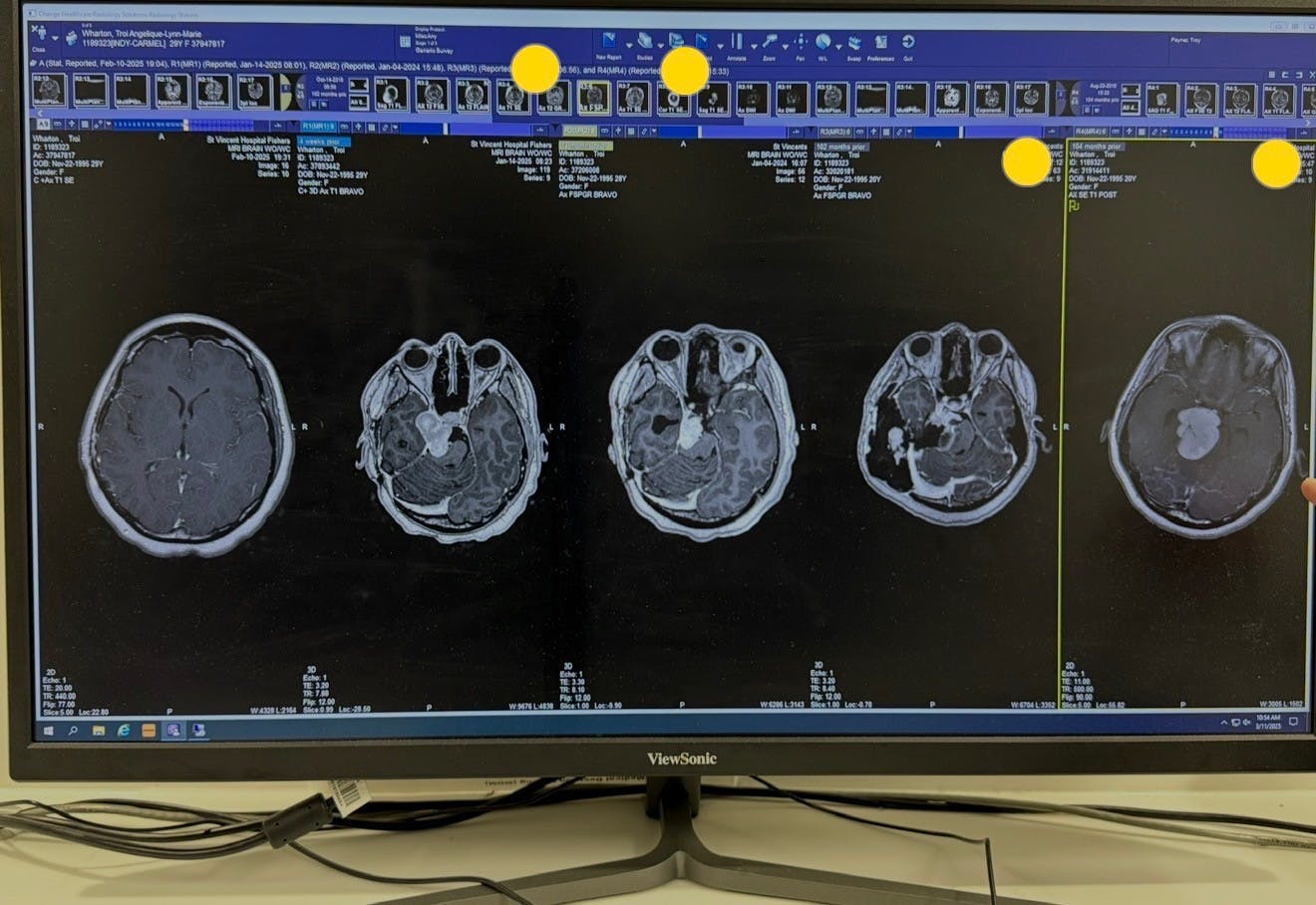
It was the same emergency department Wharton had visited days before by herself. This time, her mother demanded answers. A CT scan finally revealed what months of symptoms had been pointing toward: an abnormal mass on Wharton’s brainstem.
The diagnosis felt cinematic in the worst way. A doctor came in, sat down and put a hand on her shoulder. As he began to speak, Wharton said the words started sounding muffled, like adults in a “Charlie Brown” cartoon. She thought about her whole life.
“What did I do for this to happen to me?” she said. “I’m in school, I’m doing what I’m supposed to do, I eat my broccoli, and I drink my water and I’m respectful to my parents. I’m a really good kid, and I’m just minding my business and this came out of nowhere. I just wanted to play Pokémon Go and go to school.”
The tumor was benign, but Wharton is careful about that word.
“Benign is not fine,” she said. “Benign will still mess you up, as you can see. It can still affect you and your health greatly. Again, benign could kill you.”
At the main St. Vincent Hospital, Wharton met her neurosurgeon, Dr. Troy Payner. She noticed the name immediately. Troi and Troy.
“That’s a good sign,” she remembered thinking.
Payner showed her the MRI. The tumor was about the size of a golf ball and located in the brainstem, a critical area responsible for functions including balance, breathing, swallowing, heart rate, facial movement and other involuntary processes. It was large, oblong and difficult to remove.
Wharton was given options: monitor it, attempt radiation or undergo surgery. She did not hesitate.
“Take it out,” she told him. “I’m dying here. I’m literally dying.”
The surgery was expected to take a few hours. Recovery, she was told, might be a few days, possibly with some rehabilitation.
Wharton withdrew from Ivy Tech and tried to handle school paperwork, financial aid and medical documentation while preparing for brain surgery. She said the administrative process felt tone-deaf to what she was facing. She had been a full-time student. Now, she was dropping everything to survive.
Doctors prescribed steroids to control inflammation, but they caused severe insomnia. While the rest of the house slept, Wharton stayed awake through the night watching comfort shows and replaying the “woulda, coulda, shoulda” questions in her head.
Maybe she should have gone to the doctor earlier. Maybe she should have taken the cruise fatigue in January more seriously. Maybe she should have applied to IU on time. Maybe she should have been farther in life before something like this happened.
“It really was like a woulda, coulda, shoulda,” she said. “I did have regrets.”
Days before surgery, her symptoms became impossible to manage at home. She fell in the kitchen, and an ambulance took her to the hospital. Because swallowing had become dangerous, she was placed on a nothing-by-mouth diet before surgery.
On surgery day, Wharton remembers talking to the anesthesiologist about Pokémon Go. Then everything went black.
The procedure that was supposed to take about three hours lasted 19. During the surgery, Wharton suffered several strokes. Some tumor tissue remained because it could not be safely removed. She did not wake up right away.
About two and a half weeks later, Wharton emerged from a coma.
“It was like a blink, and then I was in another room,” she said. “No dreams, no none of that. Just darkness.”
Before surgery, Wharton had shaved her head. Her mother shaved hers, too. When Wharton’s family first saw her after the operation, her head was swollen. Her father had to help steady her mother in the ICU.
When Wharton finally became conscious, she could not speak. She was on a ventilator. She later received a tracheotomy and a feeding tube. She could not eat. Her left side was paralyzed. Her left arm hung “like a noodle.” Her left leg would not support her. She had permanent nerve damage in her left extremities. She communicated by writing on a notepad with her right hand.
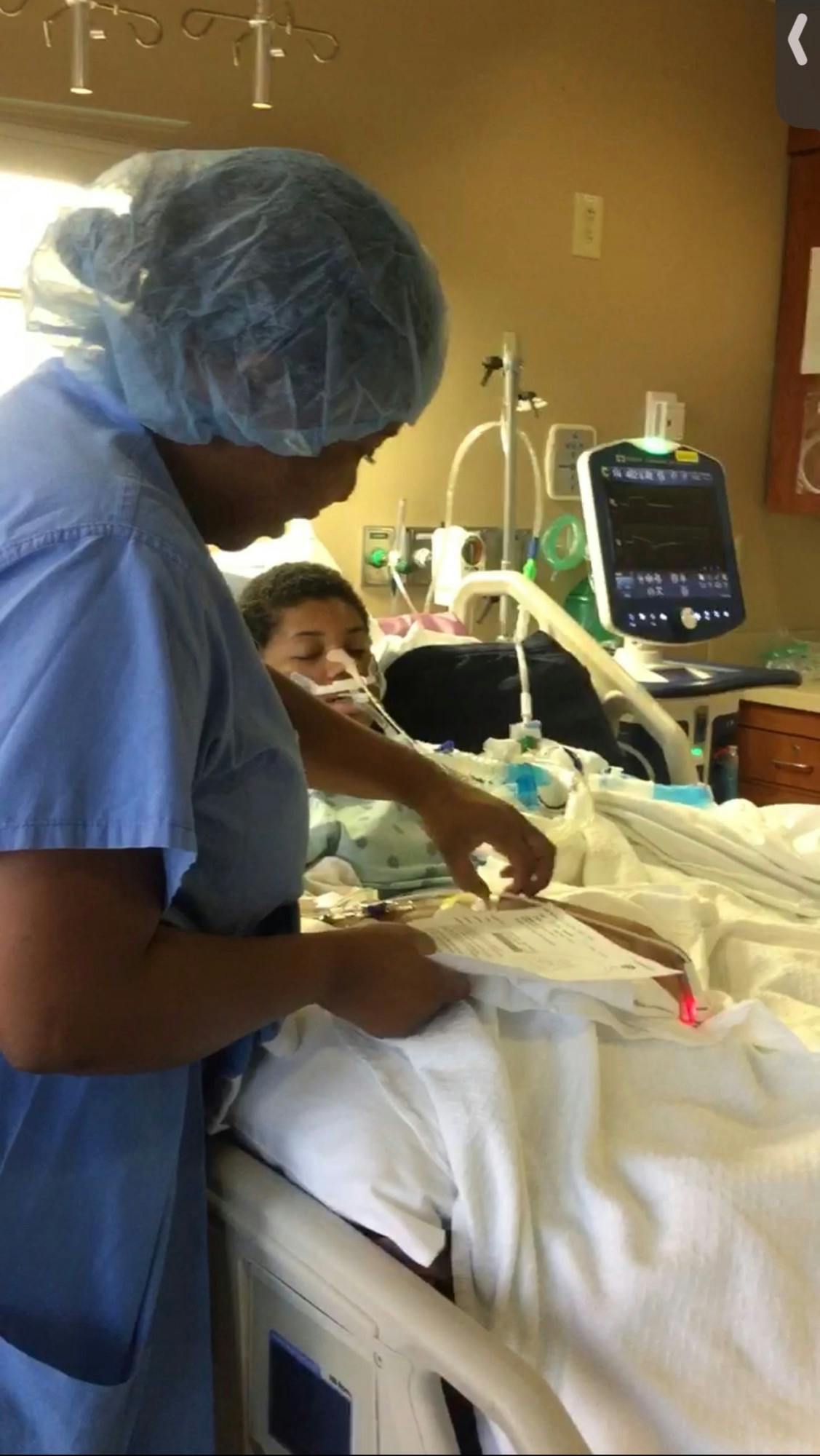
Her family would come into the room and ask how she was doing. She wrote that she was OK. She asked about her younger sisters and how their first day of school went.
“I was isolated from the world,” she said.
She was still Troi, though. Even when she could not speak, she wrote jokes. She wishes she could find that notepad now.
There were moments that still bother her. Nurses talked about her in front of her, assuming she could not understand. Some speculated about her parents’ relationship because her mother and father visited on different schedules. Wharton, eyes closed because of severe light sensitivity, heard them.
Wharton is careful when talking about medical care. She praised many nurses, doctors and therapists who helped her survive and regain independence. She credits RHI with helping her “get back on her feet, literally.”
But she also remembers moments when she felt ignored, underestimated or treated differently.
In 2025, when she returned to RHI after her second surgery, Wharton said she was first taken to an older unit despite being told she would be placed in a newer brain injury unit. Her father questioned it, and she was moved.
The experience reinforced something Wharton already knew: Patients often need advocates. Disabled patients need advocates. Patients of color need advocates. And people who are both disabled and people of color often carry an even heavier burden.
Wharton does not want those experiences to erase the care she did receive or the good providers she encountered. But she does want institutions to listen more closely and design systems that do not require patients to fight for dignity while they are already fighting to heal.
When her mother came back, Wharton wrote that the nurses had been talking and thought her parents were divorced.
Her mother read the note and knew Wharton was still there.
“Oh yeah, Troi’s fine,” Wharton remembered her mother saying, because Wharton had used the right form of “their.”
She spent about two to three weeks in the ICU, then moved to a brain injury unit before transferring to the Rehabilitation Hospital of Indiana, known as RHI. From August to November, hospitals and rehabilitation facilities became her world. At RHI, she had to relearn almost everything.
She learned how to sit up. How to transfer from bed to chair. How to get dressed. How to bathe. How to use one hand for tasks that once required two. How to stand. Walking came later.
The first time therapists placed her in a harness over a treadmill, her legs hung beneath her.
“I was hanging up there like SpongeBob,” she said. “My legs just hung there.”
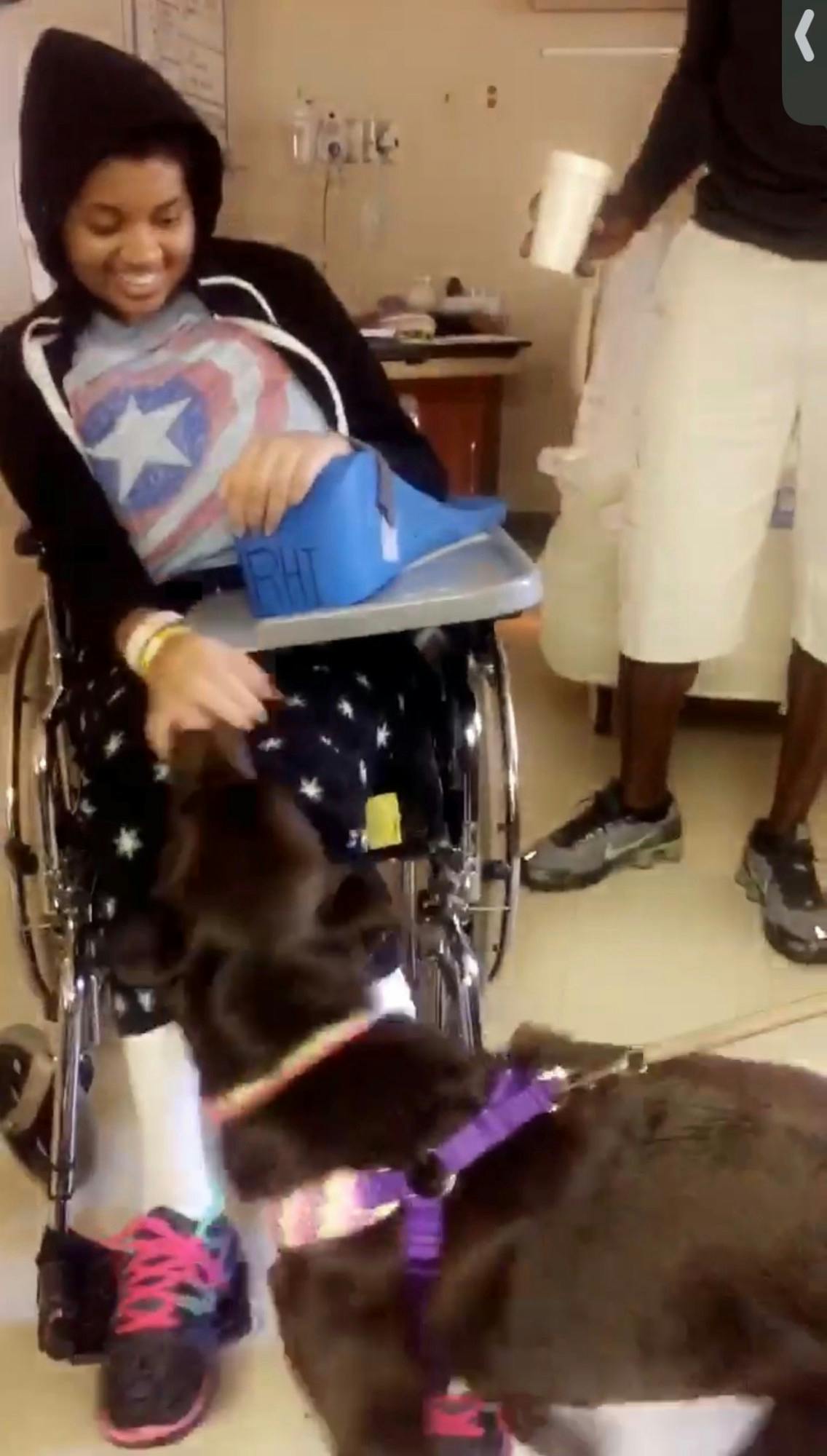
She eventually left RHI in a wheelchair. At home, therapists and nurses came to the house. Her parents helped with transfers, wound care and daily needs. Her father carried her up and down the stairs when she wanted to shower or watch a movie with the family. Wharton said home is where she truly learned to walk again.
It took about 10 months to move efficiently around the house with a cane. First, she used a quad cane. She hated that it was purple, but used it anyway. Eventually, she moved to a single-point cane. Then, over time, she began walking without one. The same person who once ran track through her neighborhood was learning how to lift her knees correctly, align her arms with her legs and think through every step.
“I went from running track in Hamilton County to learning how to walk again,” she said.
For a while, school was not on her mind. Survival was. But as she regained independence, Wharton started thinking about driving. RHI had a return-to-driving program, and she completed simulations and road training. Because her left side was impaired, her car needed modifications: a spinner knob on the steering wheel and an extension for the turn signal so she could operate it with her right hand.
Regaining the ability to drive gave her another piece of independence back. Around the same time, her parents encouraged her to consider returning to school. Wharton resisted at first. She knew if she went back only because others wanted her to, she would not do her best.
“I need to go when I want to go,” she said. “When I want it myself is when I’m gonna do my best.”
By 2020, the thought became more serious. Payner had once described her future as a “60-year plan,” meaning she could still have decades ahead of her. That echoed in her mind.
“What can I do with this 60 years?” Wharton asked herself. “If I can walk on a treadmill, I can walk to class.”
She applied to Ivy Tech again. When she received her acceptance letter, she wrapped it and placed it under the Christmas tree for her parents.
But even that return came with another medical challenge. Annual imaging showed the remaining tumor tissue had grown. Wharton was referred for radiation. She would start school in January and radiation in February.
Radiation took place Monday through Friday for about seven to eight weeks. Every morning, she and her family left early enough to arrive by 7 a.m. She had to wear a mold over her head that she said looked like a “Jason mask.” The treatment was outpatient, but exhausting.
Her first semester back at Ivy Tech, Wharton took two eight-week courses in the first half of the semester and two in the second. After radiation appointments, she came home by about 8:30 a.m., logged into classes and worked until dark.
She earned straight A’s. She made the dean’s list that semester --- and every semester after that at Ivy Tech. Wharton graduated from Ivy Tech with two associate degrees and two technical certificates in business administration and general studies. She was invited to speak at commencement for the Hamilton County campus.
“There wasn’t a dry eye in the whole crowd,” she said.
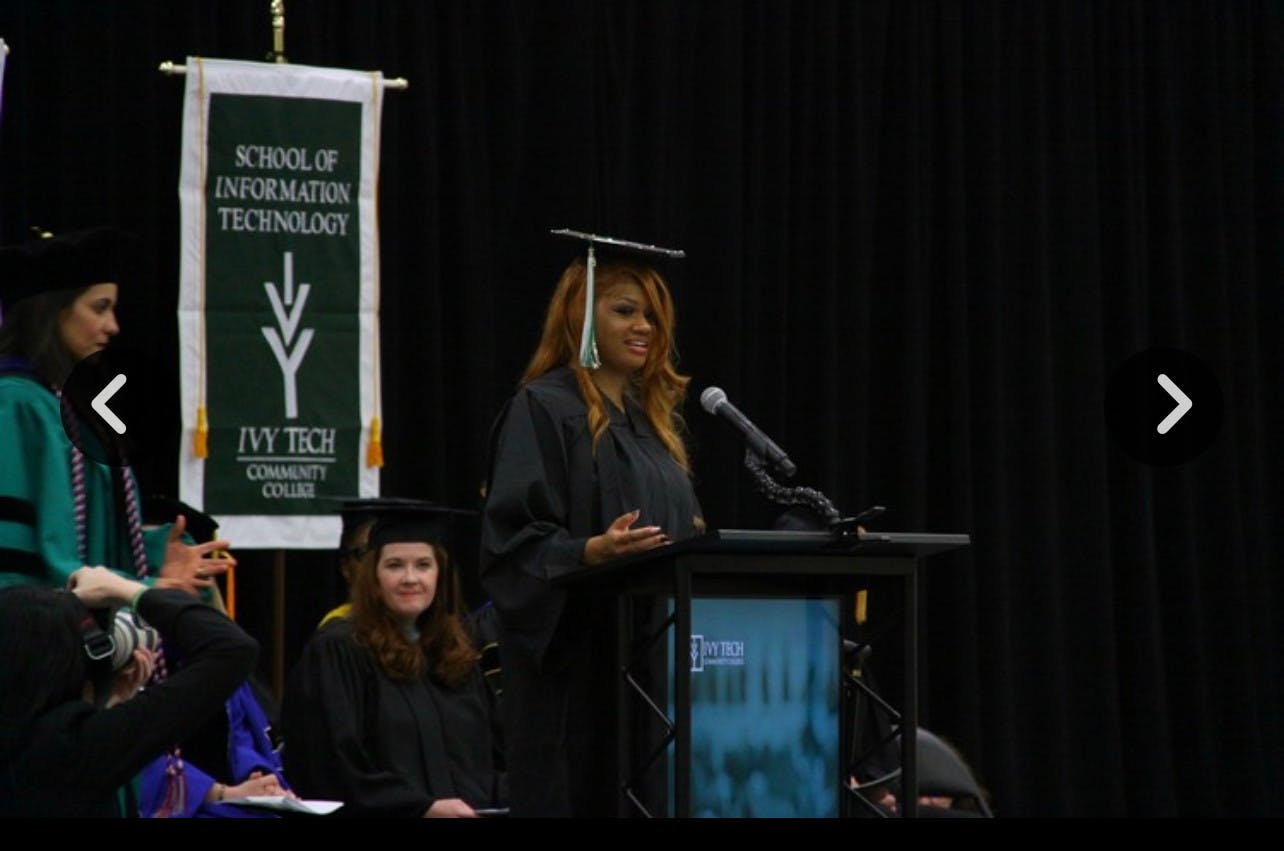
The moment mattered not only because she had returned to school, but because her parents had modeled that education could happen later, after obstacles and on a nontraditional timeline. Her mother graduated from Ivy Tech after Wharton’s first surgery. Her father, a Senegalese immigrant, military veteran and Army major, earned an MBA from the Kelley School of Business.
Seeing her father graduate from Kelley, Wharton said, was a “canon event” in her life.
When she returned to school, she knew she wanted business. To her, business meant decision-making. And after becoming disabled, she saw how often decisions about disabled people are made without disabled people at the table.
“The reason why I wanted to be in business is because I want to be a decision maker,” Wharton said. “I feel like a lot of people who are making decisions for people in my community don’t know what it’s like and aren’t in my community.”
She transferred to Kelley School of Business Indianapolis at IU Indianapolis, already “degreed up,” as she put it, but still wanting the four-year degree she had once been denied the chance to pursue.
At Kelley, she found academic challenge, faculty support and another round of health complications.
In fall 2024, Wharton began experiencing symptoms again during I-Core, Kelley’s integrated core semester. She was her team’s liaison, which her teammates interpreted as leadership. She scheduled meetings, delegated tasks and kept the project moving while her own health deteriorated.
Her right eye became blurry. Her hearing in her right ear became muffled, like being on a plane or underwater. Her headaches worsened. She was losing vision while sitting through lectures, then leaving class to meet with her team.
“I was really just being a good sport,” she said. “I didn’t want to be a complainer.”
She had learned to tell professors when she needed help, but telling classmates was harder. She worried people would think she was making excuses.
“I know I’m hardworking,” she said. “Even if I was going through hell last year, I wanted to power through it for myself.”
Her team earned an A on the I-Core project.
By spring 2025, the tumor had shown more growth. Wharton’s headaches became so severe she cried at school. Her father had to drive downtown to take her to the emergency room, leaving her car on campus --- something out of character for someone who said she was always early to class and determined to get her money’s worth.
She was placed on steroids again, which disrupted her sleep. She woke up at 5 a.m. and used the extra time to go to the gym in her apartment building before class. Then she studied by what she and her father called “dictation,” repeatedly writing down slides and notes until the material stuck.
At the same time, the tumor affected the motor function in her face. Her right eye drooped. Her smile changed. She developed Bell’s palsy. For someone studying marketing and business, where networking and presentation matter, the change was devastating.
“I feel like I lost my smile,” she said.
By May, she made the decision to stop driving. No doctor forced her. She chose it because she was dizzy, afraid something might happen on the interstate and unwilling to risk hurting herself or someone else.
It took away another piece of independence.
She still enrolled in summer courses because she had set her mind on graduating in spring 2026. The classes were online, which helped, but exams still required her to go in person.
By June, she was experiencing aura seizures every day, sometimes every 20 minutes. She described them as waves of nausea, dizziness and disorientation, not the kind of seizure people imagine from movies, but enough to make her stop where she was.
One day, before an exam, she had one in the hallway outside the testing office. There was nowhere to sit, so she leaned against a wall and waited for it to pass. Then she went inside and took the exam.
During the exam, she fell asleep for about 30 minutes. When she woke up, she realized what had happened, answered the remaining questions and submitted it.
“I need to give myself some grace,” she said. “And I am the least likely, out of everyone, to give myself some grace.”
Her second brain surgery was scheduled for July 29, 2025. This one would be different: a skull-base procedure to reach the growth that had branched from the original tumor tissue.
The first time, she had shaved her head. This time, she had locs and did not want to lose them.
“I don’t want [hospital staff] trying to figure out how to work around my locs in the OR,” she said. “I’d rather it be me.”
So, before surgery, she cut the locs she believed were in the surgical area and saved them in a plastic bag so they could eventually be reattached.
She also did something she could not have done in 2016: she scheduled text messages to send to her family while she was under anesthesia.
A week before surgery, she wrote messages to her mother and family group chats. Some were comforting. Some were jokes. Some were memes. She wanted to ease the stress she knew her mother had carried during the first surgery.
“I wanted it to be a little bit more easygoing,” Wharton said. “I wanted to make sure that she was feeling OK.”
The first message went to the family chat while Wharton was in surgery.
“Hey guys, I just want to let you know that I’m OK,” it read.
Then the jokes began arriving.
Her mother later told her she was laughing in the waiting room, unsure whether it was appropriate because other families were quietly waiting for updates. Wharton was glad.
“I know my family,” she said. “I know how they are.”
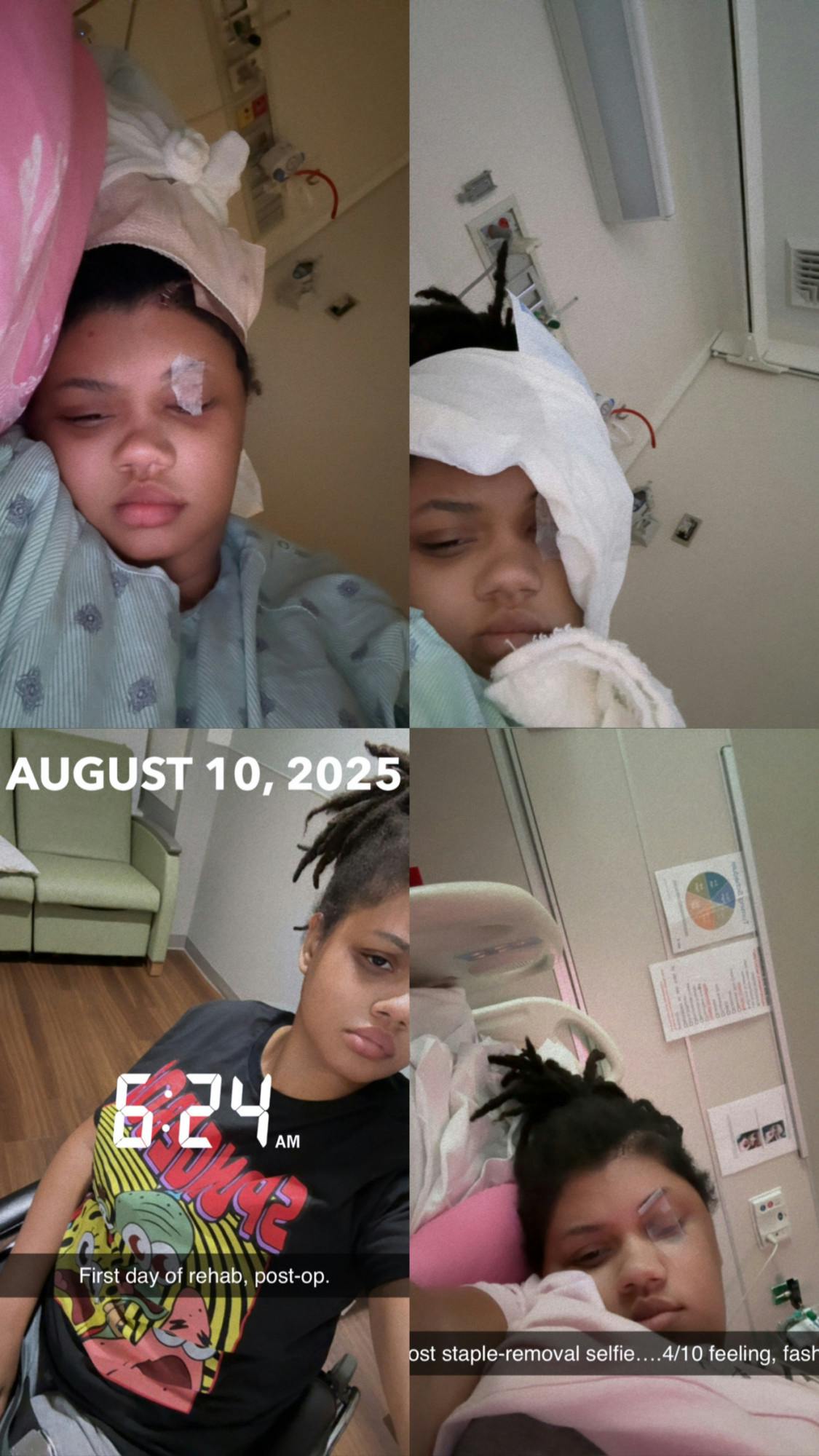
After surgery, Wharton woke up. This time, she could speak. That changed everything. During the first surgery and recovery, she had not been able to advocate for herself verbally. In 2025, she could tell nurses when she was in pain. She could explain who she was. She could say she was a Kelley student, a marketing major and someone planning to graduate in the spring.
“It may seem like something small to someone else,” she said, “but to me, compared to the last time, being able to say, ‘I’m in pain, my pain level is a 9, I need medication as soon as possible’ --- that meant a lot to me.”
But the surgery also brought a new loss. Wharton realized she was completely blind in her right eye.
She discovered it while using her phone. Her eye looked open on the camera, but when she covered her left eye, everything went black. A nurse checked her pupil with a light. It did not respond.
“I don’t see any light,” Wharton remembered saying.
She FaceTimed her parents in tears.
“Oh my God, it’s gone,” she said.
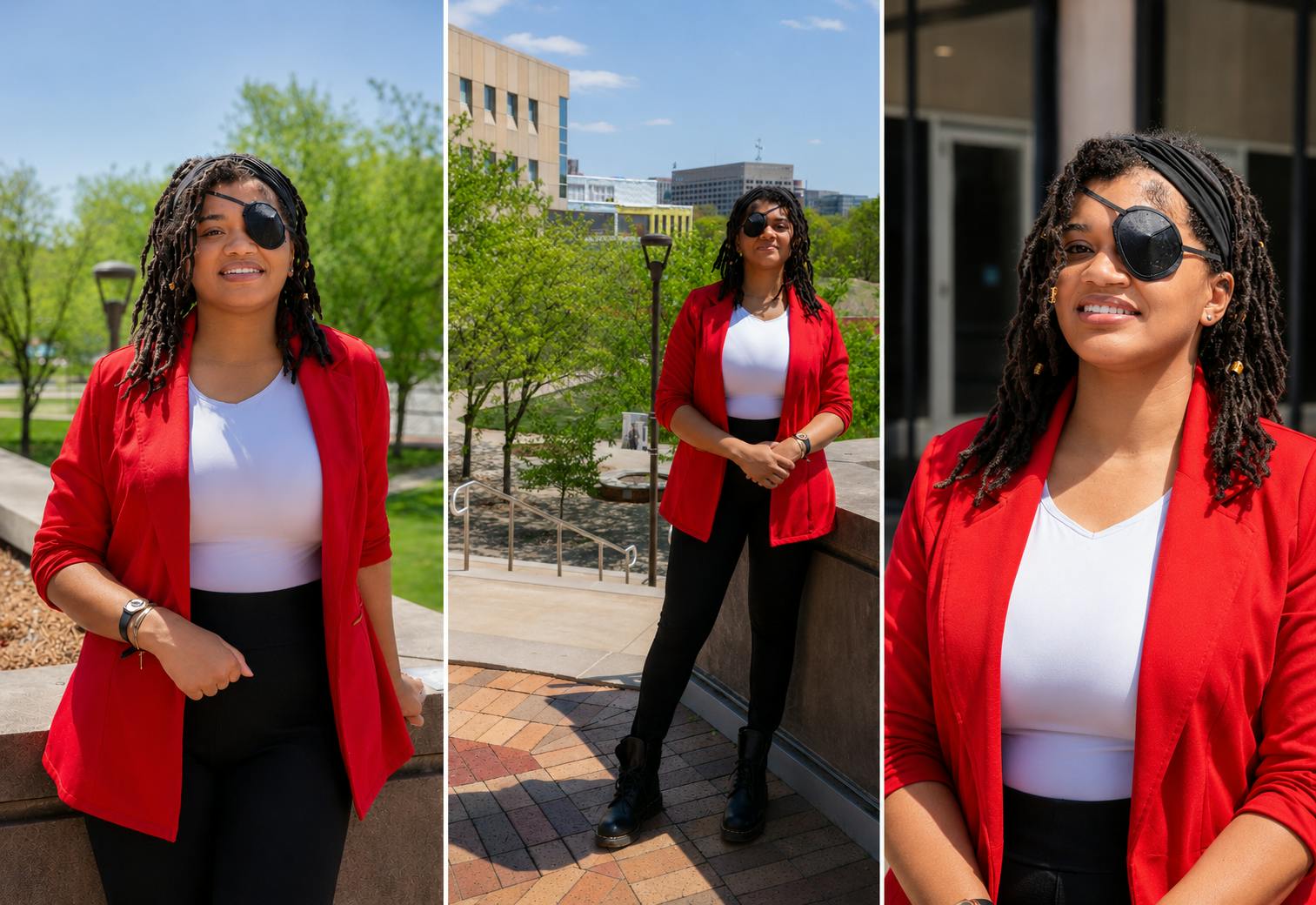
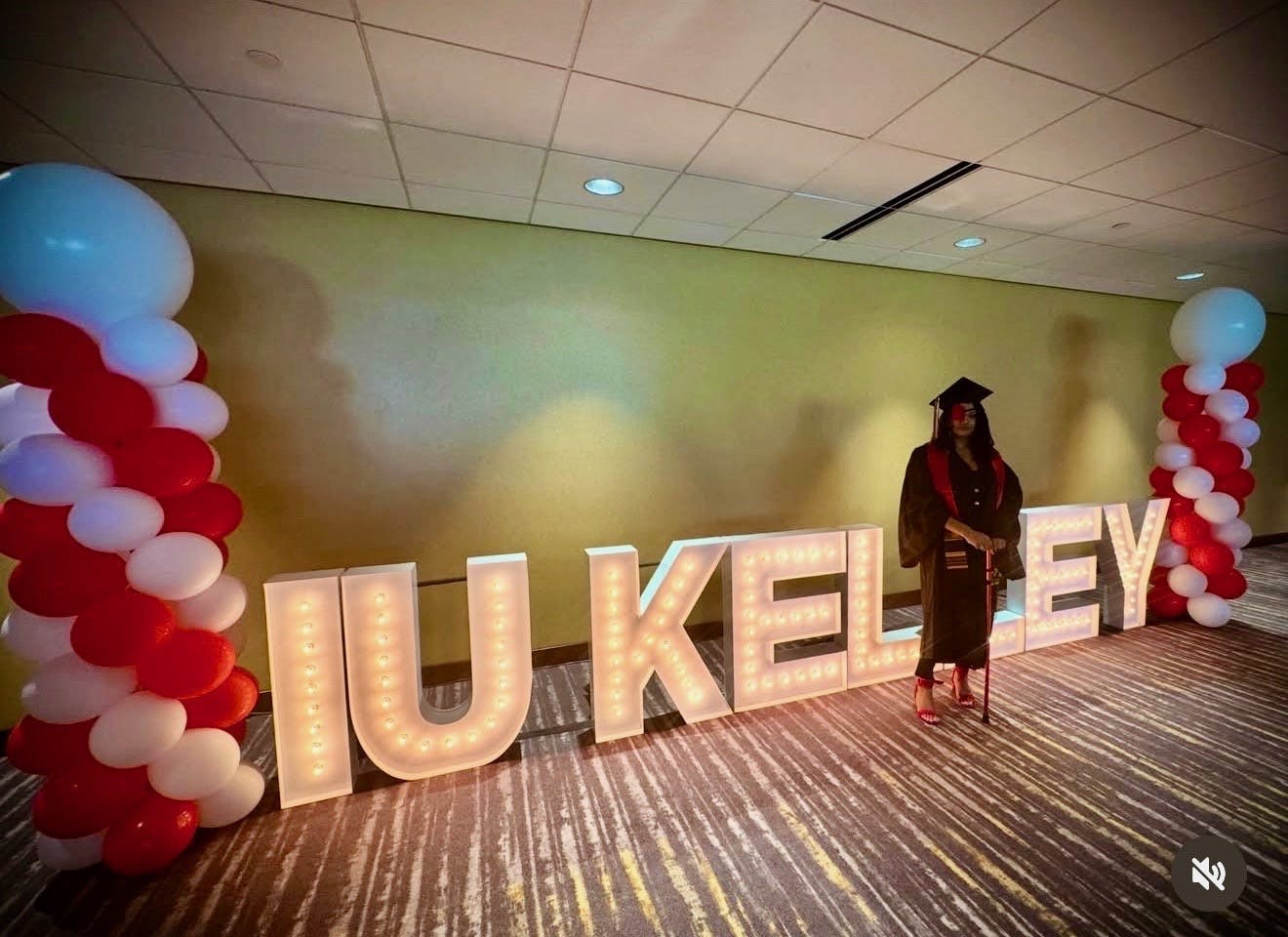
The eyepatch she now wears is partly aesthetic, partly comfort and partly function. Her right eye does not move the same way as her left, and the eyepatch helps with peripheral challenges. Over time, she has become more comfortable with it. For graduation, she found one that matched her crimson cap and gown.
“A crimson eyepatch? That would be hard,” she remembered thinking.
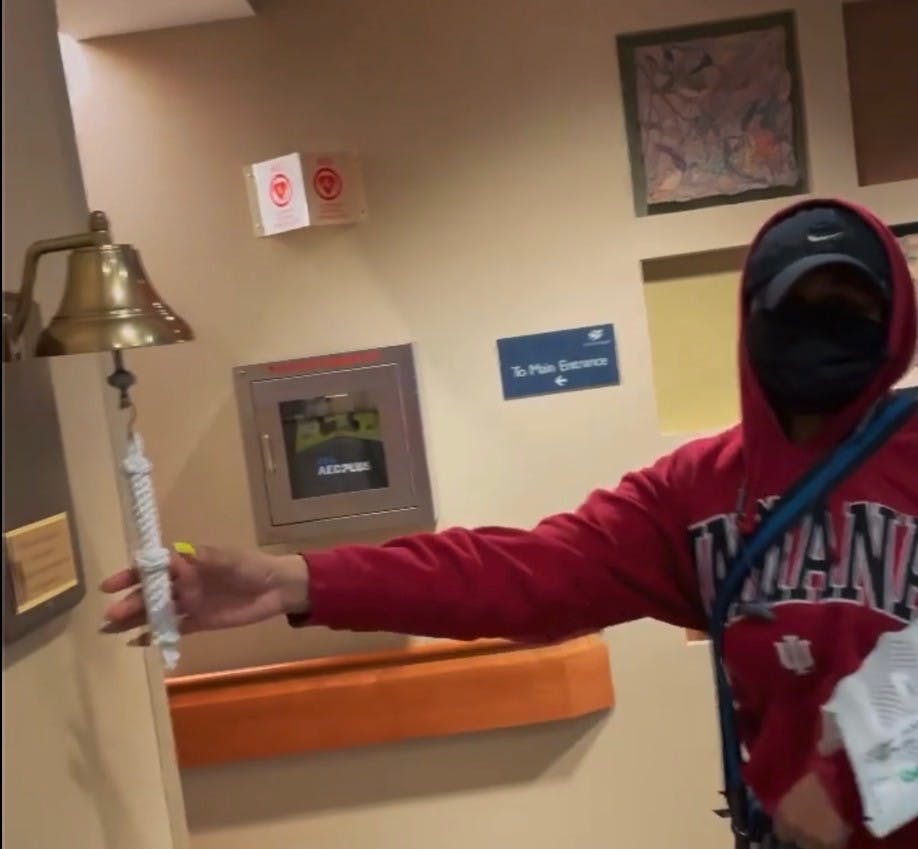
After the second surgery, Wharton returned to RHI. The place carried painful memories from 2016, including moments when she felt unheard, mishandled or talked over. But representatives told her the brain injury unit had been renovated, with single rooms and better amenities. Wharton said she agreed to return only after making her concerns clear.
She wanted privacy. Safety. Autonomy. She wanted to know that things that hurt her the first time would not happen again.
When she arrived, however, she said she was first taken to the older unit rather than the new one she had been told about. Her father questioned it. Within an hour, she was moved to the new unit.
For Wharton, that moment was not just about a room assignment. It was about being believed, being heard and having someone beside her who knew how to ask questions when she was too exhausted to fight another battle.
She said she did not want to disrespect RHI, which she credits with helping her get back on her feet “literally.” But she also wanted staff to know she remembered what happened in 2016 and needed to feel safe, autonomous and respected before returning. For Wharton, that moment was not just about a room assignment. It was about being believed, being heard and having someone beside her who knew how to ask questions when she was too exhausted to fight another battle.
Wharton said the experience made her think about how race, disability and patient advocacy intersect. She is careful not to blame every staff member. She also praised many nurses and therapists. But she said she has learned that disabled patients, especially patients of color, often must advocate more forcefully to receive what they were already promised.
At RHI, she returned to “boot camp.” Therapists came at 6 a.m. for vitals, medication, washing up and therapy. This time, though, she was not starting from zero.
Some nurses remembered her from 2016. Back then, she had arrived on a stretcher and could not speak. Now, she could tell them about her life: returning to school, driving, living in her own apartment, studying at Kelley and planning to graduate.
“They never got to hear my actual voice,” she said.
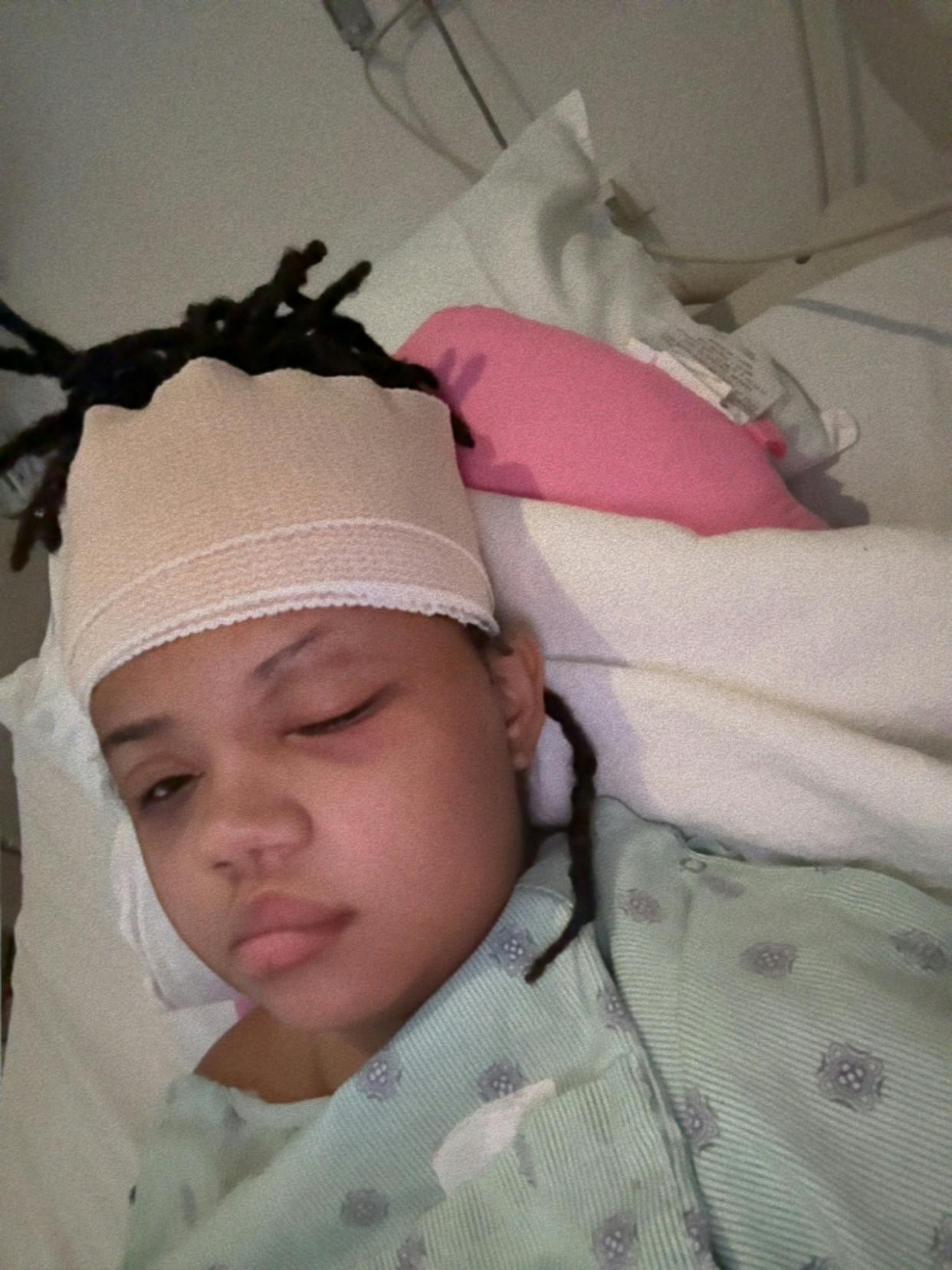
She still used many of the techniques RHI had taught her years before: dressing with one hand, putting on socks with one hand, moving safely and adapting daily tasks around her left-side weakness. In occupational therapy, she made an omelet. She cracked eggs with one hand, whisked them, seasoned them and showed therapists how she moves glass bowls along a counter instead of carrying them across the room.
Her occupational therapist watched and told her that crossed cooking independently off the list. Wharton also had to relearn in new ways. She worked on tying shoes with one hand, doing laundry, getting dressed, walking and completing cognitive exercises. She took a six-minute walk test, improving enough to be discharged.
She rang the bell for the second time in her life at RHI before going home.
This time, her mother moved into Wharton’s downtown apartment to help her recover. They set up a workstation for her mother’s remote job and settled into a new routine. Then, one day, they found two tiny stray kittens in the hallway. They fostered them for about a week, then decided to keep them both. Wharton had them registered as emotional support animals.
By early 2026, Wharton was preparing to return to Kelley. She met with her adviser in November to plan the spring semester. She did not want to lose momentum. She did not want to get too comfortable away from school.
“I didn’t get this far to get this far,” she said.
Her mother moved out shortly before classes resumed. Wharton still could not drive, so she paid for Lyft rides to and from campus four days a week. Though she lived only five or six minutes away, downtown prices and surge rates added up quickly.
She went to class Monday through Thursday and outpatient therapy on Fridays. She was adjusting to being blind in one eye, walking through crowded hallways, handling fluorescent lights and dealing with worsened light sensitivity and short-term memory challenges.
Her physical therapists had tailored her recovery to the life she was determined to return to.
“I told them, my goal is to go back to school,” Wharton said. “I go in person, and I walk through crowded hallways.”
At first, she used a cane. By March, she started leaving it at home. The first time was accidental: she was rushing for a Lyft and forgot it. Then she decided the accident meant she might not need it.
“That means you don’t need it,” she told herself.
She kept going.
For Wharton, the milestones most students never think about became private victories: walking into class without a cane, staying through lectures despite fatigue, sitting near the front so she could see, asking for a stationary chair instead of a rolling one and making it through the week before therapy on Friday.
Those daily victories also made Wharton notice how many spaces are not built with disabled students in mind.
Before her first semester at IU Indianapolis, she did a dry run of campus to figure out where she would park and how she would get to class. She found accessible parking near Kelley, but said the spaces were limited and hard to find.
“It’s easy to assume that every student who is young is able,” Wharton said. “That’s not fair, and that’s not true.”
In one class, Wharton said she fell out of a rolling chair during lecture while reaching down to move her cane. There were about 60 people in the room. For several minutes, she said, no one moved.
Eventually, she had to ask someone to help her up.
“That’s all I can think about,” she said. “I can’t think about the lesson.”
After that, she began asking professors at the start of each semester to help her arrange a stationary chair. Sometimes classmates helped her find one. She remembers the kindness of students who saw her enter and immediately went to look for a safer chair.
Wharton completed her capstone while managing lingering symptoms. The class required memorized presentations, but she requested an accommodation allowing her to use notes. At first, she considered trying to push through without help. Then she reconsidered.
“Some things, like, you really just should ask for help,” Wharton said. “Or ask if you can be accommodated for this, and not try to suffer in silence.”
In May 2026, Wharton graduated from Kelley School of Business Indianapolis.
The moment was not just about a degree. It was about the body that had been through two brain surgeries. The legs that had hung in a treadmill harness. The eye that could no longer see. The left side that still carried permanent nerve damage. The student who had once applied late and been denied admission to IU campuses, then returned years later with Ivy Tech degrees, dean’s list honors and a Kelley diploma.
At commencement, a classmate who had worked with her during I-Core noticed she was falling behind as graduates exited. He stopped and waited for her.
Wharton noticed. She notices things like that now.
She also notices what people cannot see. Traumatic brain injury, she said, is often treated like an invisible disability. Without the eyepatch or limp, people may not understand what she is managing. With them, they sometimes make assumptions.
“People sometimes assume that I think as slow as I walk,” she said.
That assumption is part of what she wants to challenge.
Wharton hopes to work in accessibility marketing or consulting, using both her business education and lived experience to help organizations make better decisions. She wants to prevent other people from being overlooked by systems that were not designed with them in mind.
Accessibility is also part of why Wharton chose business. She does not only want to talk about barriers after they happen. She wants to be in the room before decisions are made.
“There’s a lot of people making decisions for people like me who haven’t lived this life,” Wharton said. “Maybe they have the data, but if I am at the table, I can provide a voice for others.”
She sees accessibility everywhere now: inaccessible buildings, limited disabled parking, automatic door buttons that do not work, hospital policies that ignore patient autonomy, medical processes that assume straight hair, graduation gowns without pockets.
“Accessibility is really important to me,” Wharton said. “I had to learn the hard way how important this thing is.”
She wants decision-makers to understand that disability is not always distant or theoretical. Life can change fast.
In a graduation post, Wharton wrote that she learned early that people are “one accident, one diagnosis, one unexpected phone call” away from a different life.
She is still funny. Still sharp. Still a “meme queen,” as she calls herself. Still into pop culture, Marvel, comics and cartoons. Still able to turn a rehabilitation memory into a story about a fellow patient yelling, “Get off of me, you Oompa Loompa,” when a nurse tried to give him a blood clot shot at breakfast.
She laughs easily, but not because the story is light. Sometimes, she said, you laugh to keep from crying.
Wharton wants people to know a traumatic event does not have to be the end of a life. It can be a dividing line. A before and after. But not the final page.
Her story now includes the west side of Indianapolis, North Central, Hamilton Southeastern, Ivy Tech, St. Vincent, RHI, Kelley, two brain surgeries, radiation, a coma, a wheelchair, a cane, an eyepatch, two kittens, a crimson graduation gown and a stage she once had no guarantee she would ever walk across. Ten years after learning how to walk again, Troi Wharton walked the Kelley graduation stage.
And she is not finished.
Salsabil F. Qaddoura is the Editor-in-Chief of The Campus Citizen. She is an undergraduate student on a pre-law track with a minor in business and is pursuing a nonprofit management certificate. She is passionate about public service and volunteerism to better our communities and the world.

Q&A Interview: IU Luddy Indy Media Arts Lecturer Albert William retires after 35 years
By Zachary Aigbe | May 24Albert William, a Media Arts (3D) faculty member at IU Indianapolis began working with IU in 1991 in the School of Medicine, later earning his New Media --- later called Media Arts --- degree in Dec. 2002, and joined then-IUPUI’s School of Informatics --- later called the Luddy School of Informatics, Computing, and Engineering, Indianapolis --- faculty shortly afterward in 2003. His long career spans 35 years with IU Indy, and specifically 23 years within Luddy; his beginnings with the school spanning even further back from his early involvement in the New Media program around its earliest days in 2000 – back when classes were first being offered at the school, as he was a Master’s student at the time. This makes him not only one of the longest-tenured Luddy faculty members, but also one of the last ones from the school’s earliest days as well, including his time as a student there. At the end of the 2025-26 academic year, William retired.

Collaborative mass casualty simulation takes learning beyond the classroom for IU medical students
April 25The dark night explodes with the cheers of thousands of fans as they flood the streets of downtown Bloomington to celebrate Indiana University’s College Football National Championship victory. Suddenly, this festive scene turns chaotic — someone has fallen from the upstairs balcony of the pub, another person is overcome by smoke inhalation from a burning vehicle, and a loud noise causes the crowd to stampede.
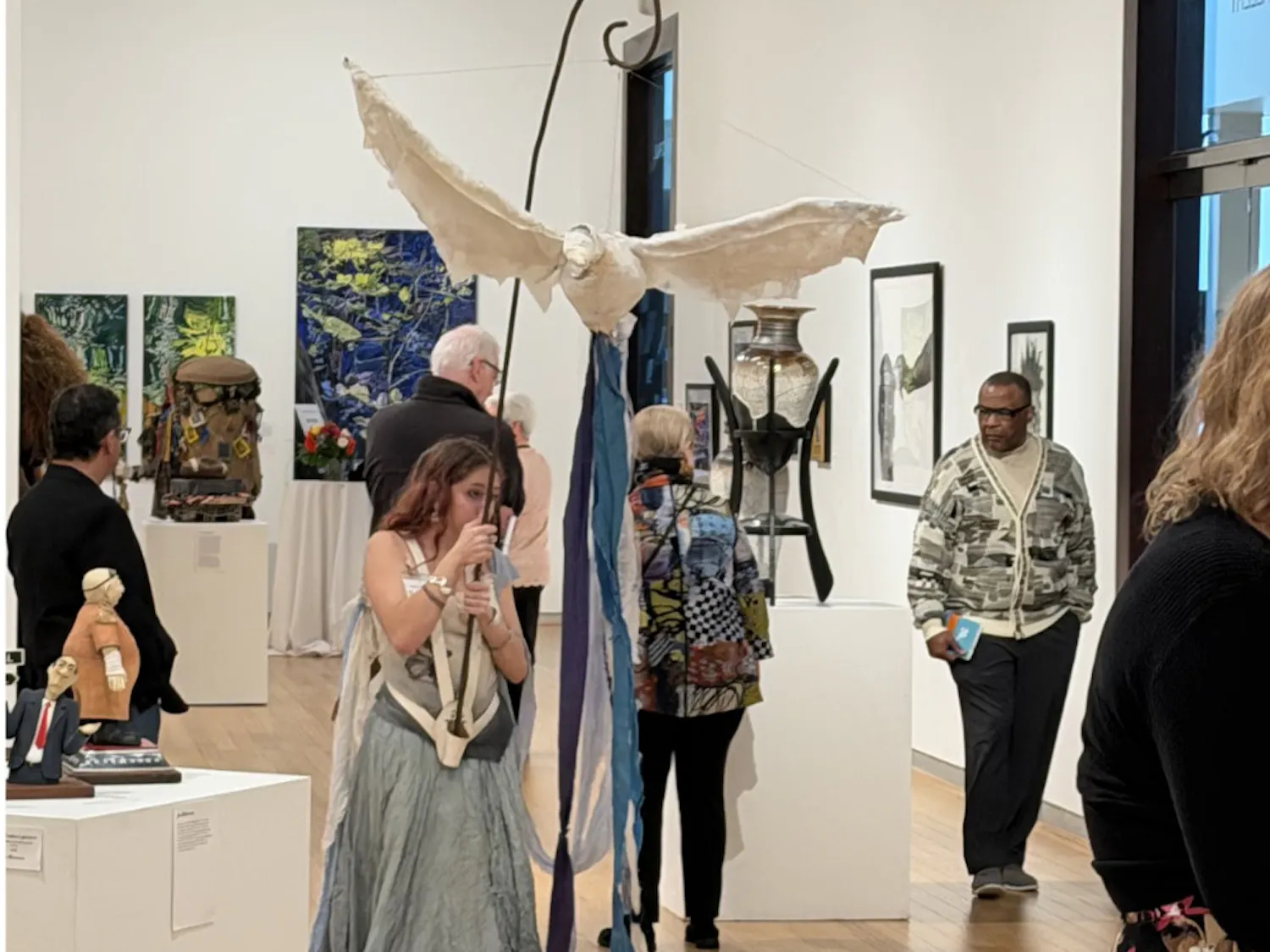
Salon art: Allen Whitehill Clowes exhibition at Herron
By Devin Bates | April 8The Herron School of Art and Design, Indiana University’s own art school, is hosting an annual exhibition, the Allen Whitehill Clowes Collaborative. The exhibition is put on alongside Clowes Charitable Foundation and Hoosier Art Salon. This year's show began on March 7 and continued until April 4, 2026. The exhibit shows Indiana’s top Hoosier Art Salon awardees of the year and others as a part of the competition.
