
Editors Note: Some sources have been granted anonymity in the interest of student safety. Interviewees are anonymous unless they otherwise gave consent to be named in the article.
In early September, the Trump administration started their “crackdown” on the city of Chicago. This was done by enacting a federal initiative “Operation Midway Blitz,” with the purpose of targeting undocumented immigrants in Chicago. Due to the increase of U.S. Immigrations and Customs Enforcement (ICE) raids, the residents of Chicago have taken to protest, and there is concern for the state of Indiana and how the recent developments could impact the state.
While Illinois Gov. J.D. Pritzker has been vocal about his discontent with President Donald Trump, Indiana Gov. Mike Bruan, on the other hand, has shown favor to Trump's agenda.
“In one of my first acts as governor, I made it clear that Indiana would not be a safe haven,” Braun stated on X. “Indiana is not a sanctuary state.”
A sanctuary state is a state that limits cooperation with the federal government. Sanctuary states alongside Illinois are California, Colorado, Connecticut, Delaware, Massachusetts, Minnesota, Nevada, New Jersey, New York, Oregon, Rhode Island, Vermont, Washington and the District of Columbia.
The statement given by Braun has caused tension within communities in Indianapolis, with students on campus feeling as if they are prolonging the inevitable. While the number of raids in Indiana is less than the number of those in Chicago, fear is still instilled into communities, mostly when it comes to law enforcement.
“I know [for] my cousin, the cops showed up to their house and he doesn't have papers… at that time there were a lot of cases of ICE [agents in the area so] they didn't want to open the door,” said Student A, a Mexican-American student. “It was just a misunderstanding. But, because of what was going on, they were scared.”
Braun has encouraged the Indiana police to help ICE agents with detaining undocumented immigrants. As a result of this, students have been affected in more ways than one. One student notes that the process to become a legal citizen may take longer than expected.
“As of right now we are not being directly targeted but I know that it is going to come,” said Student B, a Honduran-American student on campus. “Both of my parents have lost their jobs due to their immigration status… my mom is still in the process of getting her papers, but she's been in line for 12 years.”
Children of undocumented immigrants no longer feel safe knowing that their parents could be unexpectedly detained.
“What if I go to school one day and I come back and they are not there. So it's definitely affected my college life, adult life [and] what I do now,” said student B.
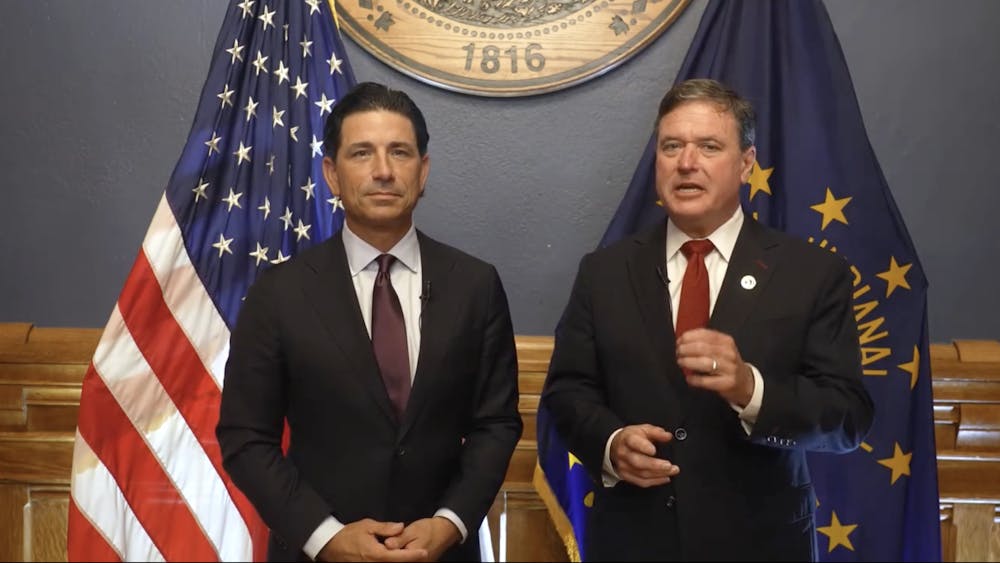
On Nov. 6, Todd Rokita, attorney general of Indiana, sued Indiana Public Schools (IPS) in an effort to allow ICE agents access to schools.
“IPS currently maintains policies that frustrate ICE’s ability to do its job,” said Rokita. “It severely limits [the] ability to access school grounds when necessary and prohibits IPS employees from assisting or sharing information with ICE.”
Rokita is working alongside Chad F. Wolf, executive vice president of America First Policy Institute (AFPI). AFPI is a non-profit organization that aims to advance policies and put the American people first. A policy they are focused on is homeland security and immigration. Their priority is to strengthen border patrol and protect the American people, interest and way of life.
“We’ve seen MS 13 gang members sitting in high school classrooms or in Iowa when we had a school superintendent who was an illegal alien and wanted for federal weapons charges,” said Wolf. “It is happening across the country and it's something we don't want to allow to happen here in Indiana.”
The anti-sanctuary law, also known as Senate Bill 181, is a bill that is intended to be used to enforce Senate Bill 0590. SB 0590 makes the state of Indiana an anti-sanctuary state while SB 181 allows the attorney general to sue any college, university or unit of local government that does not comply with ICE agents.
“The anti-sanctuary law gives my office the ability to sue any local entity that obstructs ICE and that's exactly what we are doing,” said Wolf.
For students this is more than just another bill. It affects their way of life and most importantly their education.
“To me it's very disheartening,” said Student B. “But it's also something that helps me keep going in terms of I have to keep getting my education and I have to keep fighting.”
Jaki Torres Garcia is a freshman studying forensic biology and biology and is a writer for The Campus Citizen. She enjoys reading, drinking coffee and spending quality time with loved ones.

IU Indianapolis cancels 57th MLK Dinner; students organize events across campuses
By Salsabil F. Qaddoura | Jan. 19IU Indianapolis’ annual Martin Luther King Jr. Dinner, a campus tradition that has spanned nearly six decades, was cancelled this year, prompting frustration among students and leading a series of student-led events across Indianapolis on MLK Day.

Defeat of Trump-backed redistricting bill highlights stakes for IU Indianapolis students
By Salsabil F. Qaddoura | Dec. 11Indiana lawmakers delivered a rare rebuke to President Donald Trump on Thursday, Dec. 11, voting down a controversial mid-cycle redistricting bill that would have dramatically reshaped Indiana’s congressional map and weakened the political influence of Indianapolis residents, including thousands of students at IU Indianapolis.

Day of Action for Sudan: Indianapolis
By Umu Sow | Nov. 17On Sunday, Nov. 9, in downtown Indianapolis, students, leaders, and community members from across Indiana rallied for Sudan in the cold and snowy weather.
