
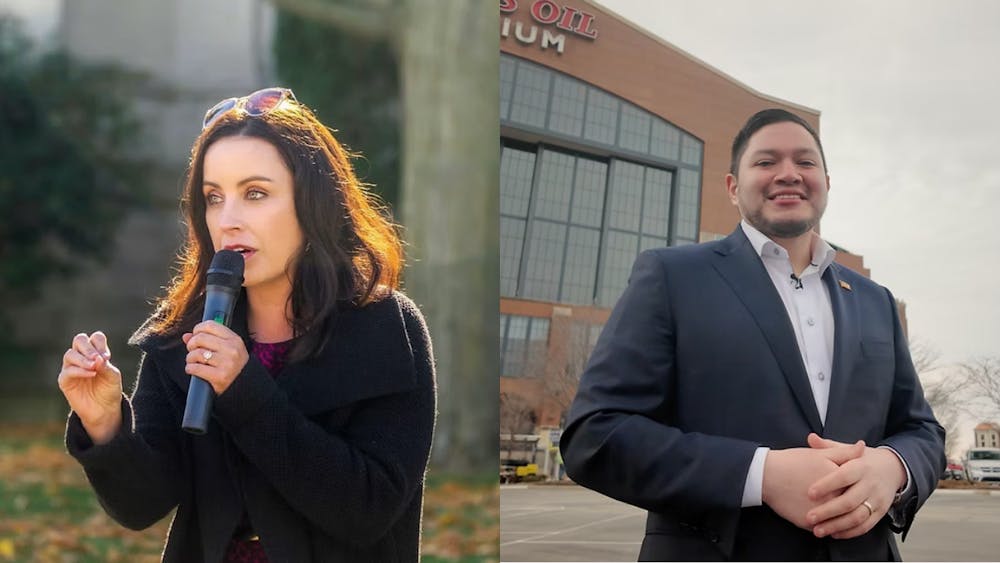
On May 5, 2026, Indiana's 7th Congressional District will hold its most competitive Democratic primary in years. André Carson, an 18-year incumbent, is facing a real challenge for the first time since his 2008 victory. District 7 — which encompasses IU Indianapolis's campus — is a reliably safe Democratic house seat, meaning the primary winner will likely go on to represent the district in Washington.
The Campus Citizen spoke with two of the leading Democratic challengers: Destiny Wells and George Hornedo. Wells comes in with a military background, having served in Afghanistan and now serving as a lieutenant colonel in military intelligence. Wells is an IU alumna and earned her law degree from the University of Texas in 2011.
Hornedo served as a political appointee in the U.S. Department of Justice during the Obama Administration and later worked with the Obama Foundation before launching his own consulting practice. Hornedo attended Cornell and Harvard before earning his law degree from George Washington University.
The Campus Citizen reached out to Congressman Carson's office; his office did not respond by press time.
The Campus Citizen spoke with both challengers about the issues most affecting IU Indianapolis students, focusing on campus safety, housing costs, transportation infrastructure and safety for international students. We also provide our own take on why IU Indianapolis students should show up to the polls on May 5 — and why your vote matters.
Indianapolis applied for a $20 million federal transportation grant and lost to peer cities like Cleveland and Kansas City. What's your district's infrastructure priority?
According to a previous Campus Citizen article, over 85% of IU Indianapolis students commute to and from campus every day, which makes this issue so relevant. Potholes are rampant around campus, and many students face car troubles as a result.
Wells
Wells pointed directly at Carson's committee assignment. He sits as a member on the Committee on Transportation and Infrastructure, she noted, and is said to have brought $1 billion back to Indiana.
“He likes to say, ‘I've brought $1 billion back to Indianapolis,’ and I'm always like, ‘where is it?’ If you're in charge of roads and sidewalks, this is not good,” she said.
She explained that congressional earmarks — direct funding requests that lawmakers bring back to their districts — were shut down in the early 2010s due to Tea Party-era corruption, then revived around 2021 under the label “Community Project Funding.” A congressperson can now bring back up to 15 projects per year, totaling between $10 million and $50 million. Carson has brought back $30 million total — Wells believes more can be done.
Her bigger concern was where those dollars are actually going. Carson’s 2025 project awards included $2 million for X-ray explosive detection machines at the Indianapolis Airport Authority — equipment supplied by Leidos, a major defense and technology contractor.
“There are only a few companies that hold that technology. One of them is Leidos,” Wells said. “So, it's a very safe assumption that the $2 million he brought back won't have an economic impact on the community. We're not going to have building trades out there fixing roads — it's going to the defense contractor. And when you see the defense contractor's political giving, they donated to the congressman.”
Then, Wells credited Republican Congressman Jefferson Shreve, who represents Indiana’s 6th Congressional District, encompassing southern regions of Marion County. In his first year, Shreve secured $11.7 million in federal funding for community projects in his district, $1.6 million of which went to roadwork. Wells argued Indianapolis should be doing the same.
Hornedo
Hornedo focused on why Indianapolis keeps losing competitive grants in the first place and what a more proactive congressional office would look like.
“The reality is most federal grant applications don’t even get past the initial threshold because they don’t meet all the various requirements,” Hornedo said.
A congressperson’s job, he argued, should be to provide in-house grant support to eligible city agencies, universities, and nonprofits before they even apply.
When an application does advance, Hornedo argued the congressperson should be the main advocate, bringing together policy voices, labor unions, and university leaders to make the case directly to federal agencies. A passive letter of support, he said, isn’t enough —
“Quarterback the operation,” Hornedo said.
He also pointed to a longer-term systemic issue: the Surface Transportation Reauthorization, the federal formula funding program that sends road money to states. Hornedo argued the formula disadvantages blue cities in red states like Indianapolis, and that a coalition of representatives serving these cities could work in-house to even things out.
“You’re addressing a formula at the end of the day, so it may not be headline news, but that is a leverage point that has outsized impact,” Hornedo said.
What would you do about corporate landlords and tenant protections — and how does that apply to students in off-campus housing?
Off-campus housing costs have risen sharply in recent years, leaving many students anxious about financing their education. This has also led to students living in unsafe areas of Indianapolis due to the affordability.
Wells
Wells argued that Indiana already has some of the weakest tenant protections in the country — the result, she said, of years of statehouse lobbying by property owners. She said that at the federal level, Congress needs to go after private equity firms buying up housing stock.
“When we allow private equity portfolios like BlackRock, who scooped up our utilities, and when we allow them to come in and buy all this housing up, it does raise the prices,” Wells said.
She used the BlackRock acquisition of AES Indiana, the primary electric utility provider for Central Indiana, as an example.
“BlackRock gave the congressman a campaign check of $5,000 on September 30th of last year,” she said, explaining that the acquisition wasn't announced publicly until the next day.
She pointed out that Carson accepted another AES Indiana check in December, when many constituents were publicly venting about skyrocketing utility bills — and he didn't comment publicly until February, after the deal was sealed.
The Campus Citizen reached out to Congressman Carson’s office for comment on the campaign contributions and his response timeline. His office did not respond.
“Here's my thing: why didn't you tell anybody?” Wells said. “I always tell people — if there was a check, there was a meeting, and if there was a meeting that you took, there was a reason.”
She also highlighted Indianapolis's eviction rate as a key indicator of the congressman's failure.
“I want to point out that Indianapolis has one of the worst eviction rates in the country,” she said. “I want you to account for whose watch this has happened on over the last 18 years. The congressman has been in office, and we have a mayor who's looking at a fourth term. I would argue there's no daylight between those two.”
Hornedo
Hornedo acknowledged that zoning and tenant laws are primarily handled by local and state offices but argued that congressional seats exist to force the conversation. “I can't make the governor and the state legislature sign tenant protections into law,” he said. Hornedo believes, however, that he can force the conversation.
He described pushing the city to consider publicly owned land for affordable housing development and advocating for a housing trust fund.
“Right now, you have the state looking at the city, the city looking at the state and the federal government sitting on the sidelines saying 'you're not my problem,'” he said. “We have to break down the silos.”
IU Indy has a significant international student population. Students are being detained and having their visas revoked at universities across the country. How would you fight for those students?
In the fall of 2024, approximately 9.6% of the student body were international students at IU Indianapolis. As of early 2026, an estimated 8,000 student visas have been revoked nationwide.
Wells
Wells, who served with NATO during Trump's first term, was direct with her perspective. “They are detaining students in their dorms. They're even going on federal installations and taking spouses of deploying service members,” she said. “This will be a stain on our country forever.”
She said she would advocate abolishing ICE and a full overhaul of the immigration code.
“In law school, the immigration column is the largest book,” she said. “It's complicated for a reason. If it takes a bunch of lawyers and they still can't figure it out, obviously we're putting an undue burden on those trying to navigate the system.”
Hornedo
Hornedo framed international students as a national asset and argued that the administration's approach undermines America's global standing.
“Be proud about the fact that folks from all over the world want to come here to get an education,” he said.
He called the crackdown counterproductive, describing it as yet another example of the impact the current administration is having on people's lives.
What's your approach to campus and community safety?
Indianapolis has a higher overall crime rate than the national average, with a total crime rate of approximately 46.56 per 1,000 residents — ranked among the top 10 for highest violent crime rates in the US.
Wells
Wells tied the safety issue back to her opening community project framework — the same dollars Carson is misallocating toward defense contractors, she argued, could be directed toward safety infrastructure around campus.
“We can bring that grant money back and put it into safety protocols in and around the university,” she said, while calling for an approach that avoids over-policing.
She also pointed to a root cause that connects directly to housing: students priced out of central neighborhoods end up in areas with higher crime rates.
“All communities are safe — just not the ones with a higher threshold of rent or housing value,” she said.
Hornedo
Hornedo argued that the city's response to crime has been reactive rather than proactive. He specifically pointed to the July 4th shootings downtown in 2025; the city's solutions were curfews, fines for families and hiring more police officers — none of which addressed the underlying conditions.
He used Baltimore and Birmingham, both cities he has worked with in his practice, as proactive examples: the cities reduced youth violence through paid summer jobs, extended rec center hours, mental health services and mentorship programs.
“Poverty is our single biggest and most shameful policy failure in this country,” he said. “One in four kids here in Indy lives in poverty. If you care about crime and public safety, you should care about poverty.”
Conclusion
IU Indianapolis students are eligible to vote for their preferred IN-7 candidate in the May 5 primaries if they are registered to vote at their campus address or a home address within the district. Early voting opened on April 6, and you must have been registered before then to cast a ballot.
IU Indianapolis’ University Library will serve as an Election Day vote center. To find the nearest location, visit vote.indy.gov/vote-centers. On Nov. 3, 2026, the General Election will take place.
May 5 presents a rare opportunity for student voters to have an outsized impact. Whoever wins the Democratic nomination will almost certainly represent this district in Washington — making this primary the vote that matters most.
Thomas Garvey is a staff writer for The Campus Citizen covering politics and culture. He studies public policy with a minor in global and international studies at IU Indianapolis, with interests in public service, foreign policy and international affairs.
Dozens gather at Monument Circle to protest immigration enforcement, joining statewide student movement
By Salsabil F. Qaddoura | Feb. 14A crowd of protesters gathered Friday evening at Monument Circle to demonstrate against U.S. Immigration and Customs Enforcement and federal immigration enforcement policies, joining a wave of student-led protests taking place across Indiana and across the country.

Mid-session recap: Indiana legislature advances bills affecting IU Indianapolis students
By Salsabil F. Qaddoura | Feb. 13As the Indiana General Assembly moves past the midpoint of its 2026 legislative session, lawmakers are advancing several bills that could directly affect Indiana University Indianapolis students, including legislation impacting university governance, state funding, faculty oversight and academic programs.

The termination of Temporary Protective Status affects thousands of Burmese Americans, most residing in Indiana
By Umu Sow | Feb. 11On Jan. 26, the Department of Homeland Security (DHS) terminated Temporary Protected Status (TPS) for Burma, also known as Myanmar. Indiana hosts nearly 43,000 Burmese people. The termination of TPS for Burma will hurt 34,575 individuals, of whom 4,000 are of Burmese descent.
