
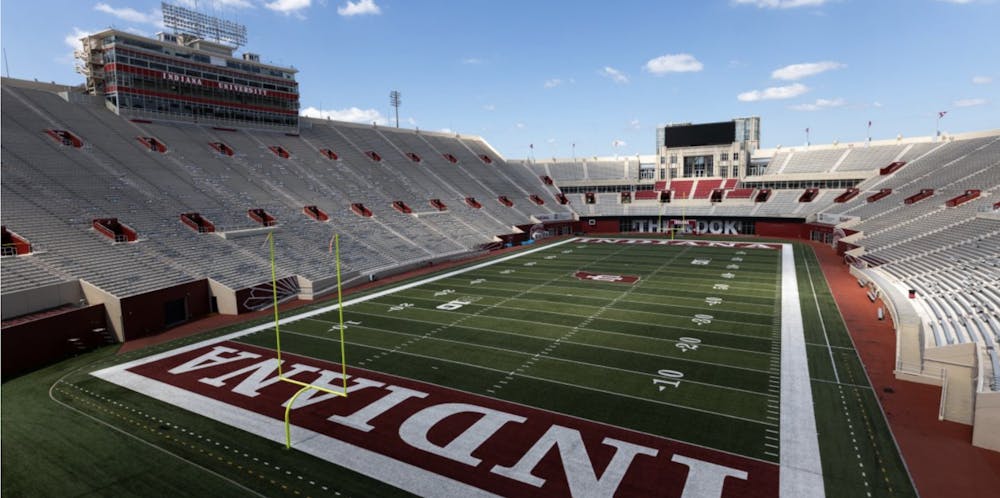
During the fall, college campuses across the country revolve around one thing: football. Tailgates fill parking lots, stadiums roar with school pride and students gather to support their teams. At Indiana University Indianapolis, however, that defining element of traditional campus life is missing. Without a football team, is IU Indianapolis a “real” campus?
Indiana University Indianapolis, formerly known as Indiana University–Purdue University Indianapolis (IUPUI), is a diverse campus located in downtown Indianapolis. As the second campus established in the Indiana University system, IU Indianapolis offers a range of Division I athletic programs, including basketball, cross country, golf, soccer, softball, swimming and diving, tennis, track and field and volleyball. Notably absent is football, a sport that often plays a central role in shaping campus identity nationwide.
Indiana University Bloomington, the flagship campus in the IU system, is the only IU campus with a football program. Since its establishment in 1866, the Hoosiers have won three Big Ten Championships — 1945, 1976 and 2025.
The team’s recent success has drawn national attention and elevated the campus’s visibility, evident by the number of attendees. During the 2025 season, IU Bloomington recorded a total home-game attendance of 425,520 fans. On Dec. 6, 2025, the Hoosiers defeated Ohio State at Lucas Oil Stadium in Indianapolis to claim another Big Ten Championship. They are ranked No. 1 in the nation in both the Associated Press and ESPN 2025 college football rankings.
This success has translated into increased funding and revenue for the university, including an estimated $2.5 million to $3 million generated from new mandatory personal seat donations.
Despite IU Indianapolis’s competitive Division I athletic programs, attendance numbers remain significantly lower. The campus set its all-time attendance record on Nov. 11, 2025, when 5,568 fans attended a Jaguars men’s basketball game. While impressive compared with the previous average attendance of approximately 1,175 fans per game, the number pales in comparison to IU Bloomington’s average football home-game attendance of roughly 53,190.
When speaking with IU Indianapolis students Sofia Argotte, Tyler Elks and Faith Wheatleynone reported attending a sporting event on the IU Indianapolis campus.
“[I] never really heard anyone even talk about them,” said Argotte.
For many students, football serves as a social hub and a key expression of school pride. This is evident among IU Indianapolis students, many of whom wear IU Bloomington Hoosier apparel rather than clothing representing the IU Indianapolis Jaguars. Some students commute to Bloomington to participate in the game-day experience.
Argotte, a communications major at IU Indianapolis, said she regularly attends IU Bloomington football games because of the excitement. She pointed to traditions such as tailgating, meeting friends before games and the overall atmosphere.
“I’ve been going for years, even before college,” Argotte said. “My cousins and I would always go with our parents, and it was something I always looked forward to.”
Rather than viewing the lack of a football team as a disadvantage, some students embrace IU Bloomington’s program as their own.
“[I’m] okay with not having a football team,” Wheatley said. “They do a great job making us proud to be Jags and Hoosiers.”
Enrollment size and funding also play a role in the disparity between the two campuses. IU Bloomington enrolls approximately 48,626 students, compared to IU Indianapolis’s enrollment of about 26,677 students, allowing Bloomington to support a significantly larger athletics budget.
While IU Indianapolis does not have a football team, it benefits from its downtown location, investment in multiple Division I sports and a shared fan base with IU Bloomington.
Although the possibility of forming a football team in the future remains uncertain, such a program could increase student engagement and campus morale. For now, IU Indianapolis continues to focus its resources on established strengths, such as basketball and soccer. Whether or not football ever becomes part of the campus’s future, IU Indianapolis is defining its identity beyond traditional expectations of what a college campus should be.
Olivia Arnold is a junior at Indiana University Indianapolis, majoring in journalism with a minor in general communications. She is a writer for The Campus Citizen. Beyond writing, she enjoys watching reality TV, reading classic literature and traveling.

FIFA World Cup 2026 group stage predictions
By Citlali Sanchez and Jocelyn Quintana | June 12The FIFA World Cup, a competition that comes once every four years, is one of football’s biggest stages, with the previous tournament pulling over five billion viewers throughout various platforms. This year’s World Cup will run from June 11 to July 19 across three countries: The United States, Mexico and Canada. The tournament highlights the top 48 nations in international football, different from previous years where the tournament included 32 participants. These countries are chosen before in an intercontinental qualifying tournament, and compete for the trophy and a $50 million prize money.

From Mexico to Indianapolis: Sofia Castillo’s journey as a student-athlete
By Jocelyn Quintana | May 13As a senior international student at Indiana University Indianapolis, Sofia Castillo has taken pride in representing her hometown of Guadalajara, Mexico, and everything that has come with being the only international player from Mexico on the women’s tennis team.

Champions League semifinals take shape after dramatic quarterfinal round
By Emiliano Magana | April 18The Champions League quarterfinals determined the four teams that would move on to the semifinals, all looking to earn a spot in the final that will be played in Budapest on May 30. The four semifinalists are Paris Saint-Germain, Bayern Munich, Atletico Madrid and Arsenal. The games will be as follows: Bayern Munich vs. PSG and Atletico Madrid vs. Arsenal.
